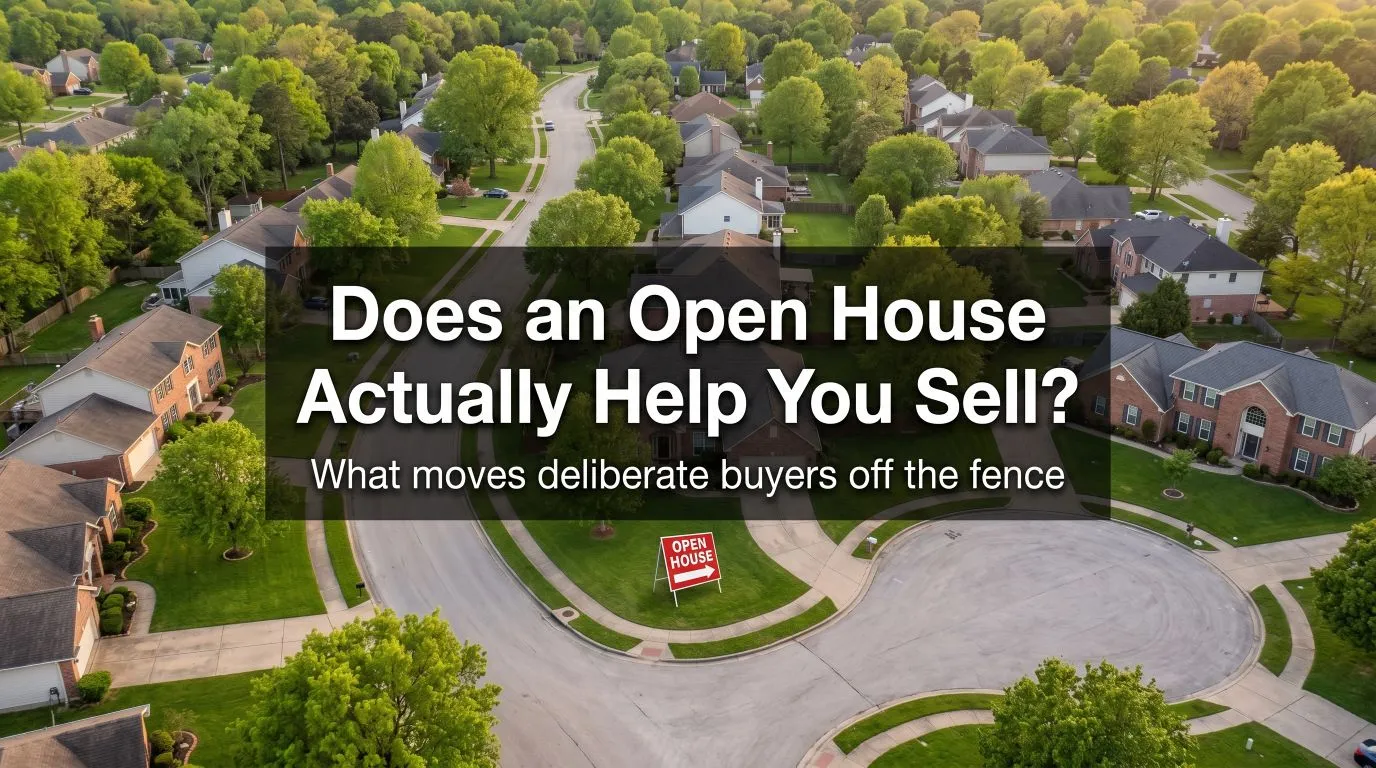
Why sellers in Clear Lake and the Greater Houston area who skip the open house are giving up the one thing that moves deliberate buyers off the fence: the psychological effect of visible competition.
Yes, an open house can help you sell, and understanding why matters more than the yes or no. The value isn’t foot traffic for its own sake. It’s what happens when two or three serious buyers move through your home at the same time, notice each other, and understand something no listing description could tell them: this home has real interest behind it. That shift in buyer psychology is the actual mechanism, and it’s the part most sellers don’t think about when they’re deciding whether the preparation is worth it.
The common objection is understandable. You’re opening your home to strangers on a weekend, and you’ve probably heard that open houses mostly attract nosy neighbors. That part is partially true. Neighbors do show up. But neighbors also know people who are looking, talk to relocating buyers moving into the corridor, and sometimes decide to list their own home after seeing what’s possible in their neighborhood. The objection worth taking seriously isn’t whether open houses attract casual visitors. It’s whether they create the conditions that move qualified buyers toward decisions. In today’s Greater Houston market, they do.
What Does the Current Greater Houston Market Mean for Sellers Thinking About an Open House?
It means buyers have both the time and the inventory to be deliberate, which is exactly the environment where an open house does the most work. According to the Houston Association of Realtors’ April 2026 Housing Market Update, released May 13, 2026:
- Single-family home sales rose 4.4% year over year, with 8,196 homes sold
- Pending sales climbed 9.4% year over year, confirming active buyer demand heading into summer
- Median sale price: $332,000, down 1.6% year over year
- Average sale price: $428,709, down 1.4% year over year
The March 2026 data adds important context: average days on market reached 67 days, up from 62 a year ago, with 34,898 active listings available to buyers, an 8.7% increase year over year.
The current market means buyer demand is genuine and building, as the pending sales figure confirms, but buyers also have more inventory to compare and more time to use it than they’ve had since before 2020. At 67 days average on market, buyers in the Greater Houston area are deliberate. They’re researching, comparing, and making considered decisions. That environment is exactly where an open house earns its place in your marketing strategy, because it creates something a deliberate buyer can’t get from online listings alone.
Why Do Half of All Buyers Attend Open Houses If So Few “Find” Their Home That Way?
Because open houses aren't a discovery tool, they're an evaluation tool, and buyers use them at a completely different stage of the search than the "3% found their home this way" statistic suggests. The 3% figure comes from the NAR 2025 Profile of Home Buyers and Sellers, and it sounds like a case against holding one. But it measures only the first step buyers took in their search, the initial point of contact. The same survey tells a different story when you look further in. 50% of buyers attended at least one open house during their home search. That’s not a marginal activity. That’s half of all buyers, in person, evaluating homes they were already serious about.
The 3% figure also ignores how buyers actually find open houses. They don’t stumble across them. They find them through the MLS, through Zillow, through their agent, through the same digital channels that account for 80% of that same survey’s first-step data. An open house is a destination buyers navigate to after discovering a listing online. Treating it as a first-step measure tells you nothing useful about its role in the purchase decision.
Open houses don’t generate initial discovery in most cases. What they do is give serious, pre-qualified buyers the in-person evaluation they need to move from interested to decided. That’s a different job, and it’s an important one.
What Actually Happens to Buyer Decision-Making When They See Other Buyers in the Room?
Seeing genuine competition changes a buyer's calculation from "I like this house" to "I need to decide now, because someone else might act first." Private showings don’t create that effect. When a buyer attends a scheduled private showing, they’re in a low-pressure environment where they can take their time, revisit rooms, and leave with no external signal about how the market views the property. There’s nothing wrong with private showings. They serve a real purpose. But they don’t create visible competition, and visible competition is a documented driver of purchase decisions.
When a buyer walks into a well-attended open house and sees two other buyers moving through the kitchen, pausing at the backyard, pointing at the ceiling height, they receive information that changes their calculation. The home is generating real interest. Someone else may make an offer. The decision they were planning to sit on for another week now has a different set of stakes. That’s not manufactured pressure. It’s social proof: one of the most reliable mechanisms in how people make high-stakes decisions. When buyers see that others with the same information are treating a home seriously, it validates their own interest and reduces the uncertainty that keeps deliberate buyers from committing.
We see this play out directly in the Clear Lake corridor. Buyers who have spent weeks comparing listings, attending private showings, and waiting to feel certain will sometimes walk an open house and make an offer the same afternoon. Not because they were rushed. Because seeing genuine interest from other buyers confirmed what they already believed about the property. The open house created conditions that private showings, 3D tours, and listing photos can’t: real-time, visible evidence that the home has earned competition.
That confirmation effect is strongest early. The first weekend a listing is on the market is when buyer attention peaks, when your listing is freshest in the search feeds, and when the conditions for a well-attended open house are most favorable. Sellers who wait several weeks before considering one are often trying to generate momentum that was available to them on day one.
When Does the Open House Advantage Concentrate Most in Clear Lake and the Greater Houston Area?
Spring is when it concentrates most in this corridor, and two buyer segments drive that. Buyers targeting a specific Clear Creek ISD attendance zone are running against a self-imposed school-year deadline. They want to close before fall, which means they’re actively moving right now, not browsing casually. Our article on how CCISD zoning affects pricing and competition in Clear Lake covers the specifics of how that buyer pool behaves and what it means for sellers in attendance zones for Clear Lake High, Clear Springs, and Clear Falls. That buyer pool doesn’t browse casually. They arrive at open houses informed and ready to evaluate.
The aerospace and engineering professional community around Johnson Space Center adds a second concentrated segment. Relocating professionals managing a cross-country move don’t have the flexibility to attend multiple private showings spread across several weekends. An open house solves a real logistics problem for them: they can see the home, walk the layout, evaluate the neighborhood, and ask questions in a single dedicated visit. Those buyers tend to arrive pre-approved and motivated, which is exactly the profile you want in the room.
Both segments are most active in spring, both have decision timelines working in the seller’s favor, and both respond to the same condition: visible evidence that a home they’re interested in is also interesting to other qualified buyers. Promotion matters too. A well-marketed open house, posted to the MLS, pushed across social media, and communicated to the neighbor network several days in advance, fills the room in a way that a last-minute listing doesn’t. Neighbors are not just curious visitors. They’re a referral channel that often knows exactly who in their network is looking in the area.
What Does a Well-Executed Open House Actually Require From Sellers?
The preparation is the part sellers sometimes underestimate. An open house that runs on short notice, with minimal promotion and a home that isn’t showing-ready, tends to confirm the “it’s just a weekend event” skepticism. One that’s been set up correctly does something different.
Condition matters more in a group setting than in a private showing. Small issues that a single buyer might overlook during a scheduled tour can generate audible reactions when several buyers are moving through simultaneously. Anything a buyer’s inspector is likely to flag should be addressed, disclosed, or priced for before the open house, not left to surface after a contract is signed. Our article on how location, condition, and pricing work together in the Greater Houston area covers which condition issues generate the most friction in this market and how to sequence your preparation before going to market.
Your agent’s presence and engagement matter as much as the home itself. A well-run open house isn’t an unlocked door. It’s an opportunity to answer pricing questions, provide neighborhood context specific to the Clear Lake corridor, and identify which attendees are serious enough to follow up with. The feedback gathered in a single open house afternoon often tells a seller more about how the market perceives their home than several weeks of private showings. That real-time intelligence is something virtual tools simply don’t provide.
The Bottom Line
An open house isn’t a formality or a routine checkbox. It’s a specific marketing tool that does something private showings don’t: it creates visible, real-time evidence that your home has genuine buyer interest, and it activates the social proof effect that moves deliberate buyers toward decisions.
Houston’s spring market is actively moving. Pending sales are up 9.4% year over year, and the CCISD-zoned and JSC-adjacent buyer pools that drive demand in Clear Lake and surrounding communities are most active right now. Sellers who combine accurate pricing, solid preparation, and a strategically timed open house are positioned to concentrate buyer activity in the window when it does the most work. Sellers who skip it are giving up a condition that no digital tool replicates.
At Simien Properties, we’ve worked with sellers across Clear Lake, League City, Friendswood, Webster, and Seabrook long enough to know which open houses convert and which ones don’t. The difference is almost always preparation and timing, not the open house format itself. If you want a clear read on whether an open house makes sense for your home and how to set one up correctly, we’re glad to talk through it.
Visit simienproperties.com or call our no-pressure concierge hotline at (281) 781-4348.
References
- Houston Association of Realtors, April 2026 Housing Market Update (May 13, 2026)
- Houston Association of Realtors, March 2026 Housing Market Update (April 8, 2026)
- National Association of Realtors, 2025 Profile of Home Buyers and Sellers (November 2025)
Get local guidance before you decide. Call our no-pressure concierge line at (281) 781-4348 or visit simienproperties.com.