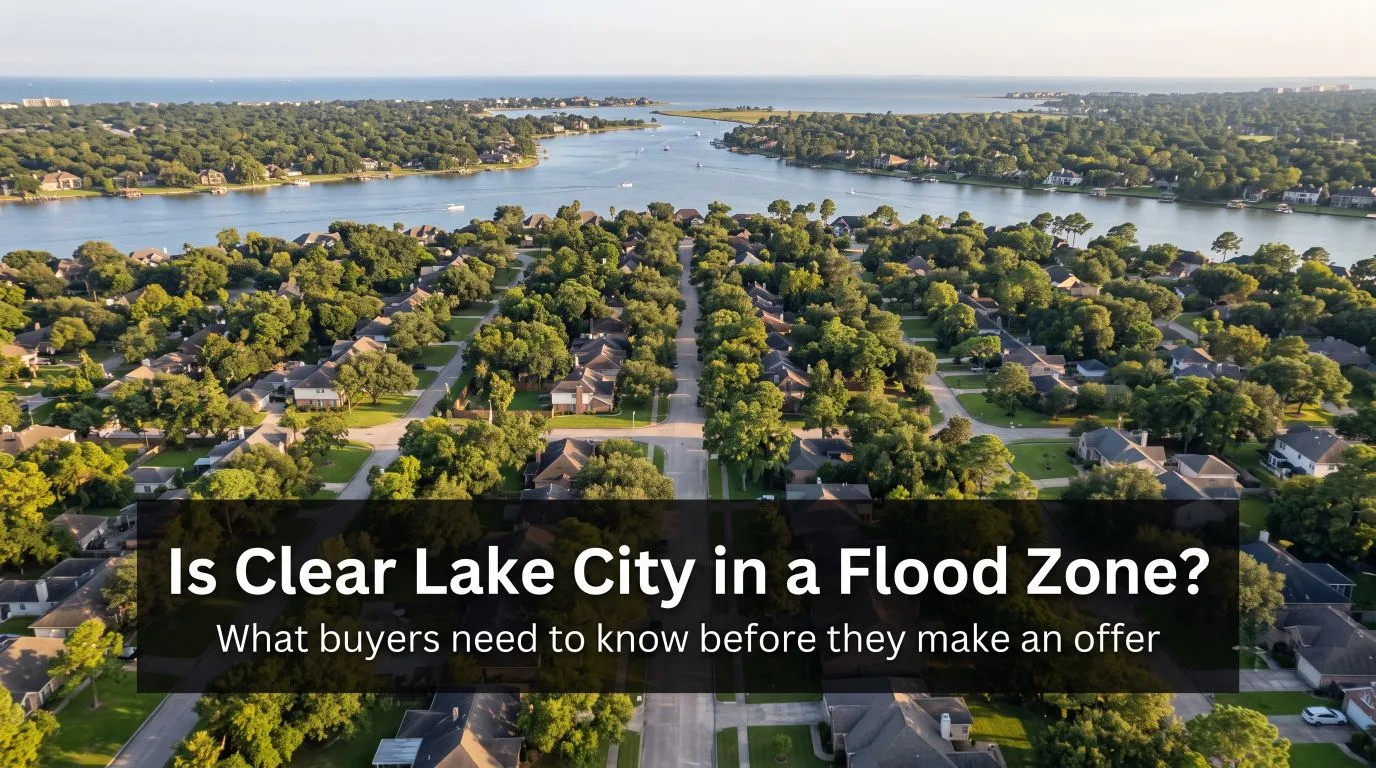
What buyers and homeowners need to know about FEMA zones, flood insurance costs, and the specific checks that matter before you make an offer in Clear Lake City.
Every Clear Lake City address has a FEMA flood zone, and which one applies shapes insurance requirements, annual ownership cost, and long-term risk in ways that vary block by block. Two homes on the same street can fall in different zones, carry different lender requirements, and differ in what they cost to own each year.
Our team has worked the Clear Lake corridor since 2009. Flood zone is one of the first two things we check for any address a buyer is serious about. This guide covers what that check involves, what the costs actually look like, and what to do before an offer goes in. For the full picture of what Clear Lake City living involves, our guide to living in Clear Lake City covers the community in full.
What FEMA Flood Zones Exist in Clear Lake City?
Clear Lake City addresses fall mainly into Zone AE and Zone X, with the regulatory floodway mapped as an overlay inside Zone AE rather than as a separate zone, and which designation applies to a given address matters more than the neighborhood it sits in.
Zone X sits outside the high-risk area, so the federal flood insurance requirement doesn’t apply, though a lender may still require coverage. It is two things, not one: unshaded Zone X is minimal risk, outside the 0.2% annual-chance (500-year) floodplain, while shaded Zone X is moderate risk, the area between the 1% and 0.2% annual-chance floodplains, and is common in this corridor. Zone AE is the 1% annual-chance (100-year) floodplain with base flood elevations, part of the Special Flood Hazard Area where the federal requirement explained below applies. The regulatory floodway is the channel plus the adjacent land that must be kept clear to carry the base flood, an overlay inside that high-risk area rather than a separate, higher zone.
The boundary between zones doesn’t follow neighborhood lines. Clear Lake City’s proximity to Galveston Bay, the elevation variation across zip codes 77058, 77059, and 77062, and the drainage patterns across the area’s bayous create significant differences street by street and sometimes lot by lot. The official lookup is the FEMA Flood Map Service Center at msc.fema.gov. Enter the specific address and get the current zone designation directly. That’s the starting point for any purchase decision in this corridor, not the listing description or the neighborhood name. Our neighborhood-by-neighborhood breakdown covers where flood risk tends to run higher, including Pine Brook and Brookwood specifically.
Does Being in Zone X Mean Your Home Won’t Flood?
No. Hurricane Harvey showed why in 2017.
Harvey dropped more than 50 inches of rain on parts of the Houston area, according to the National Weather Service. The Harris County Flood Control District’s 2018 Harvey report found that of the 154,170 Harris County homes that flooded, 105,340, or 68%, were outside the 1% (100-year) floodplain.
Zone X means the mapped risk is minimal or moderate. It doesn’t mean the property is protected from events that exceed those estimates, and in a corridor where heavy rainfall can overwhelm drainage systems and storm surge from Galveston Bay can add a second risk layer, Zone X is a starting point, not a conclusion. For surge, NOAA’s National Hurricane Center publishes National Storm Surge Risk Maps for community-level awareness, not parcel-level answers, and the National Weather Service in Houston/Galveston points to the regional Zip-Zone evacuation map.
The Harvey flood claims we saw in this corridor weren’t limited to Zone AE addresses. Zone X homes in established subdivisions took on water because the storm exceeded what the maps assumed. That’s why we look at the FEMA zone alongside the property’s actual elevation and drainage context, not the zone label alone.
When Is Flood Insurance Required in Clear Lake City?
Federal law requires lenders that are federally regulated or insured to require flood insurance on a mortgaged building in a Special Flood Hazard Area (FEMA zones beginning with A or V, which includes Zone AE) in a community that takes part in the NFIP. If a Clear Lake City property is in Zone AE and you’re financing the purchase, flood insurance is not optional.
Zone X carries no federal mandate, though a lender may still require coverage. Many buyers in this corridor choose flood insurance voluntarily given Harvey’s track record and the corridor’s Bay exposure. FEMA doesn’t use the flood zone to price an NFIP policy, so a quote for the address is the only way to know what voluntary coverage costs.
One more coverage issue worth understanding: flood insurance doesn’t cover wind and hail damage. That’s a separate policy. Clear Lake City homeowners generally buy windstorm coverage in the standard homeowners market rather than through the Texas Windstorm Insurance Association (TWIA): TWIA’s Harris County territory reaches only properties inside the city limits of La Porte, Morgan’s Point, Pasadena, Seabrook or Shore Acres, and east of State Highway 146. Clear Lake City is inside the City of Houston, which isn’t on that list, so it isn’t eligible. If you are shopping east of 146 in one of those five cities, confirm eligibility for the specific address before assuming either policy is optional. Both policies cover different risks, and both belong in your ownership cost estimate.
What Does Flood Insurance Actually Cost in Clear Lake City?
It depends on the house, not the neighborhood. Under Risk Rating 2.0, FEMA rates each NFIP policy on the property’s own details: distance to flooding sources, flood type, foundation type, first-floor height, construction type, flood openings, elevation of machinery, replacement cost, and the coverage and deductible you choose. The flood zone isn’t a rating input, though it still decides whether a lender must require coverage.
That’s why two homes in the same zone on the same street can carry meaningfully different premiums, and why we don’t quote a typical Clear Lake figure. Ask a licensed insurance agent for an NFIP quote and a private flood quote on the specific address before an offer goes in.
Run the numbers before you finalize a budget, and add the quoted premium to your monthly ownership cost. And the NFIP building coverage cap for a single-family home is $250,000. If the property’s rebuild cost exceeds that, an NFIP policy alone leaves a coverage gap that private flood insurance or excess coverage would need to fill.
What Are My Flood Insurance Options in Clear Lake City?
Buyers in Clear Lake City have two options: the National Flood Insurance Program (NFIP) and private flood insurance.
For a single-family home, NFIP provides up to $250,000 in building coverage and $100,000 in contents coverage, with standardized terms most lenders accept. Two limits matter specifically here: NFIP doesn’t cover temporary living expenses while your home is being repaired, and the $250,000 building cap can fall short of actual rebuild costs for higher-value homes in this corridor. If either is a concern, private flood insurance is worth comparing.
Private flood policies vary by carrier, so compare their limits, exclusions and start dates against the NFIP’s rather than price alone. An NFIP policy usually takes 30 days to start. There’s no wait when it’s bought in connection with making, increasing, extending or renewing a mortgage loan, and only a one-day wait when a building is newly mapped into the high-risk area and coverage is bought within 13 months of the map change.
Which one costs less depends on the specific property. Run both quotes side by side before you decide. Treat this as general information, not insurance advice: a licensed insurance agent can quote both NFIP and private coverage for a specific address.
What Should I Check Before Making an Offer on a Clear Lake City Home?
Three checks. They take less than a day and they belong before any offer goes in.
First: look up the current FEMA zone at msc.fema.gov for the specific address. Don’t take the listing’s word for it. Pull the official designation directly and confirm what it means for your lender’s insurance requirement.
Second: review the FEMA-led 2026 draft flood maps for Harris County, which the Harris County Flood Control District hosts at maapnext.harriscountytx.gov. FEMA released the draft data to local floodplain administrators in early February 2026. Drafts have no regulatory effect and aren’t open to formal appeal; the 90-day appeal and comment period opens only after FEMA issues Preliminary FIRMs, no date has been announced, and final maps are expected to take years. A property moving from Zone X to Zone AE changes whether a lender must require insurance and the ownership cost profile for as long as you hold the home. Finding this out before an offer is the right time.
Third: ask for the seller’s disclosure notice and read the flood history section. Since September 1, 2019, the Texas notice has asked whether the seller is aware of present flood insurance coverage, previous flooding into a structure, whether the property is in a 100-year or 500-year floodplain or floodway, flood damage claims filed with any insurer including the NFIP, and FEMA or SBA flood assistance. Answering is a legal duty on the form, but it covers only what the seller knows. A seller who bought after Harvey may not know whether the home took water in 2017, so ask your agent or attorney about anything the notice leaves unclear. The complete picture is the current FEMA zone, the draft map designation, the property’s elevation, and the seller’s disclosure together. We pull all of this for every Clear Lake address our buyers are serious about.
The Bottom Line
Flood zone in Clear Lake City isn’t a disqualifier. It’s a variable that shapes cost, lender requirements, and long-term ownership expense in ways specific to the address. Zone X carries no federal mandate, but Harvey showed what that designation doesn’t guarantee. Zone AE adds a required insurance cost, and buyers who factor it in honestly from the start aren’t caught off guard. The 2026 draft maps make this a live question for any address where a zone change is possible.
The checklist is three steps: look up the current FEMA zone at msc.fema.gov, check the draft maps at maapnext.harriscountytx.gov, and review the seller’s flood disclosure. We run all three before any offer goes in for the addresses our buyers are serious about.
If you’re working through flood risk for a specific Clear Lake City address, we’re glad to help with no pressure. Call our concierge line at (281) 781-4348 or visit simienproperties.com.
References
- Federal Emergency Management Agency, FEMA Flood Map Service Center, msc.fema.gov
- Federal Emergency Management Agency, Flood Zones and Floodway glossary definitions, accessed October 5, 2026
- Federal Emergency Management Agency, FloodSmart guidance on the mandatory purchase of flood insurance in high-risk areas
- Federal Emergency Management Agency, Risk Rating 2.0 Rate Explanation Guide, April 2025
- Federal Emergency Management Agency, National Flood Insurance Program coverage limits and waiting periods
- Harris County Flood Control District, MAAPnext draft flood maps (FEMA-led), draft data released February 2026
- Houston Public Media, report on the Harris County Flood Control District’s final Hurricane Harvey report, June 6, 2018
- National Weather Service, Hurricane Harvey rainfall summary (Houston/Galveston Weather Forecast Office), accessed September 26, 2026
- National Oceanic and Atmospheric Administration, National Hurricane Center, National Storm Surge Risk Maps, Version 4, accessed October 5, 2026
- National Weather Service Houston/Galveston, Hurricane preparedness and Zip-Zone evacuation map, accessed October 5, 2026
- Texas Windstorm Insurance Association, TWIA overview, accessed October 5, 2026
- Texas Legislature, S.B. 339, 86th Legislature, enrolled bill amending Texas Property Code §5.008, effective September 1, 2019
Get local guidance before you decide. Call our no-pressure concierge line at (281) 781-4348 or visit simienproperties.com.