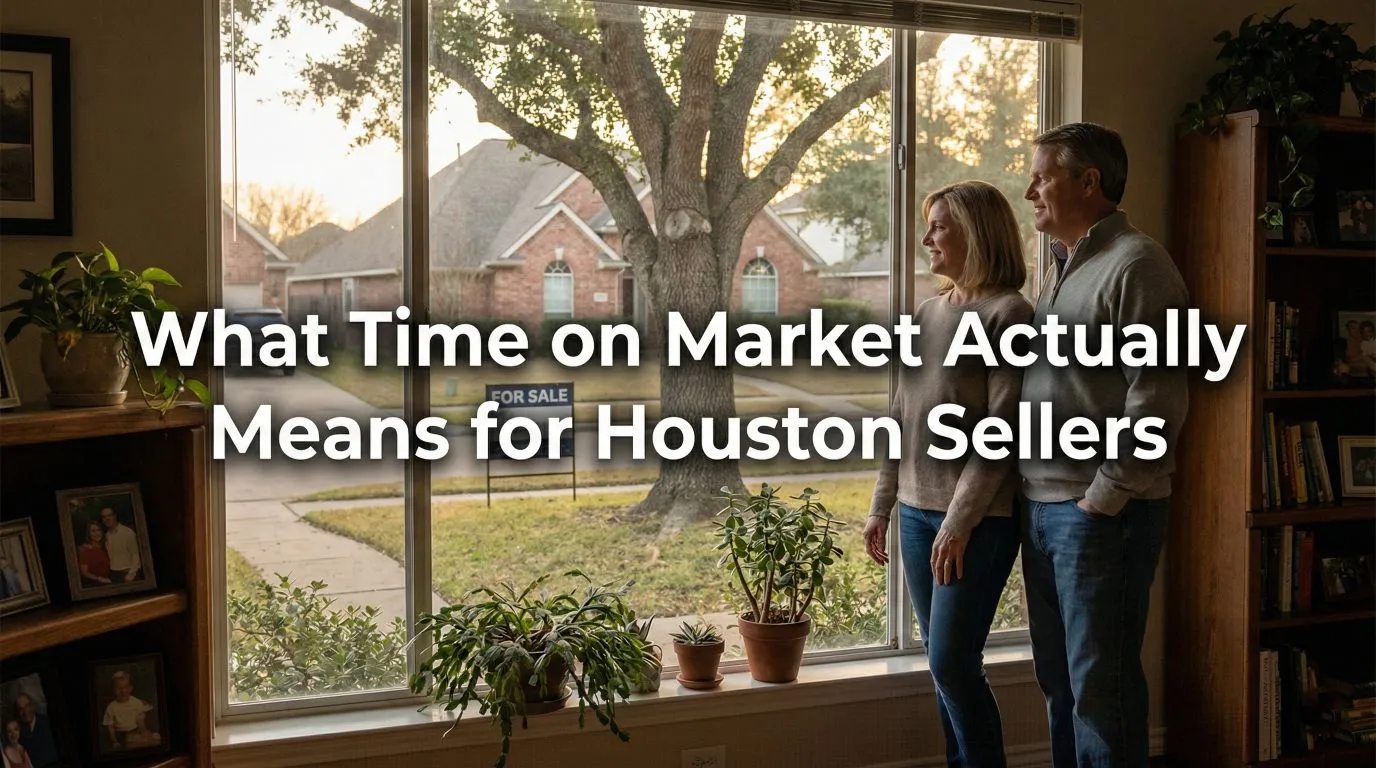
If you’re a homeowner in Houston thinking about selling, chances are you’ve been watching one number more closely than any other: days on market.
Not because you expect your home to sell overnight (most sellers know those days are behind us), but because that is a signal of how the home is perceived by the market. The longer a listing sits, the louder the questions become. What are buyers thinking? Am I losing leverage? Did I price this wrong?
The concern is understandable. Days on market has become one of the most emotionally charged metrics in today’s market. But it’s also one of the most misunderstood. The truth is that it’s more nuanced, and far less alarming, than many sellers assume.
Why Days on Market Feels So Personal for Sellers
Price changes don’t feel great. And higher days on market doesn’t either. They make sellers feel exposed.
When a seller adjusts price, it often feels like a proactive decision: something done deliberately in response to data. But when time passes without an offer, it can feel like the market is passing judgment.
Sellers worry buyers will assume something is wrong. They worry that silence means rejection and that every extra day quietly erodes leverage.
What’s important to understand is this: time itself is not the problem. What matters is what time does to buyer perception, and importantly how sellers respond to it.
Resetting Expectations: What Days on Market Looks Like in Houston Today
Houston is no longer operating on the same timeline it was a few years ago. In 2021 and early 2022, many homes sold in weeks, sometimes days. That pace was driven by historically low rates, limited inventory, and intense buyer urgency. Those conditions no longer exist.
Today, Houston is operating in a more balanced environment. Inventory has grown. Buyers are more patient. And as a result, average days on market has increased into the 60+ day range, depending on price point and location.
This doesn’t mean demand disappeared, but it does mean the market slowed to a more sustainable and deliberate pace. And comparing today’s listings to peak-market timelines is one of the fastest ways sellers create unnecessary stress. The benchmark has changed.
Here’s the key point that reframes everything:
Days on market does not directly reduce your home’s value. Loss of leverage does.
There is no automatic formula that says: “After X days, your home is worth Y percent less.”
Instead, the impact of days on market is indirect. It works through buyer behavior.
As a listing ages, buyers begin to ask different questions. Early on, attention is high and urgency exists. Over time, curiosity gives way to comparison. Eventually, expectations shift toward negotiation.
This shift doesn’t happen because the home suddenly changed. It happens because buyers assume the seller’s position may be weakening.
How Buyer Perception Evolves and How the Final Price Is Impacted
Understanding the buyer’s mindset helps sellers see why time feels so powerful.
In the early phase of a listing, buyers tend to think, “This is new. We should pay attention.” Showings feel competitive. Offers, when they come, are often cleaner.
As weeks pass, that mindset softens. Buyers begin comparing the home more critically against alternatives. They may wait to see if a price change is coming. Once a listing stretches further, buyers often assume flexibility exists, even if it doesn’t. They approach with negotiation in mind, expecting concessions, credits, or reductions.
None of this is punishment. It’s simply how humans behave when urgency fades. And this is where sellers often draw the wrong conclusion.
Homes don’t lose value because they sat for 45 or 60 days. They lose value when sellers are forced to react late rather than plan early.
Most downward pressure on final sale price comes from:
- price reductions made after momentum is lost,
- concessions offered to restart stalled activity,
- repair credits negotiated when buyers sense leverage.
In other words, value is rarely lost all at once. It’s chipped away through a series of reactive decisions. Ironically, many sellers who start high hoping to “test the market” end up selling for less than they would have if they had priced more strategically from the beginning.
Why the First Few Weeks Matter More Than the Final Few
The most important period of a listing’s life isn’t the end. It’s the beginning, as the first few weeks set the tone. They determine how buyers categorize the home in their minds. Is it competitive? Is it fairly priced? Is it something to act on, or watch?
Sellers who enter the market with a clear strategy have options, and they can wait longer without panicking. They can negotiate from a position of strength and can protect their net even if the sale takes time.
Sellers who enter without a plan often feel pressured to “fix” things later, when leverage has already shifted.
In the end, it’s not time that punishes sellers. It’s not proactively planning for it that does.
What Strategic Sellers Are Doing Differently Right Now
Sellers who perform well in today’s Houston market tend to approach days on market differently.
They price based on current buyer behavior, not yesterday’s headlines. They understand how their home compares within its specific price band and neighborhood. They plan for multiple scenarios before listing, including what happens if showings are quiet early.
Most importantly, they treat days on market as a variable, not a verdict. They understand that selling well isn’t just about speed alone, but also about maintaining control of the process from start to finish.
Top Questions Houston Sellers Should Be Asking Right Now
For sellers weighing a move, these are often the most productive questions to focus on:
- What is a realistic days-on-market range for homes like mine today?
- How sensitive are buyers in my price range to condition versus price?
- What does “priced correctly” actually mean in my neighborhood right now?
- At what point should adjustments be considered, and what kind?
- How do concessions compare to price reductions in terms of net outcome?
- What early signals should I watch to know if positioning is working?
- How does my sale timeline affect my next purchase?
These questions shift the focus from fear to strategy, and that shift alone often brings clarity.
The Bottom Line for Houston Sellers
Longer days on market do not automatically mean a lower sale price. What impacts outcomes is how leverage shifts over time and whether sellers plan for that shift or react to it.
Today’s Houston market rewards sellers who are thoughtful, prepared, and realistic. It does not reward guessing, waiting without a plan, or anchoring to peak-market expectations.
Selling doesn’t need to feel rushed to be successful. But it does need to be intentional. When sellers understand how time actually works in today’s market, they stop fearing days on market and start using it strategically.
If you’re trying to understand how your home might perform, what kind of timeline is realistic, and how to protect value without unnecessary stress, a calm, Houston-specific conversation can make all the difference.
When you are ready, we are here to support you. At Simien Properties, our concierge approach is built around clarity, not pressure. Whether the right move is selling now or waiting with a plan, understanding your position is the first step.
Visit simienproperties.com or call our no-pressure concierge hotline at (281) 781-4348 to talk it through.
If your home has been sitting longer than expected, what actually controls how long a home stays on the market covers your next move, and what matters most when selling in Greater Houston right now can help you decide what to adjust first. Our seller’s guide (opens in a new tab) has the full picture.
References
- Houston Association of Realtors (HAR), Market Updates & Housing Reports
- Texas Real Estate Research Center (Texas A&M University), Texas Housing Insight
- National Association of Realtors (NAR), Market Dynamics & Seller Behavior
- Redfin Data Center, Sale-to-List Price Ratios & DOM Definitions
Data and insights reflect Houston and Texas market conditions through 2025–early 2026. Local performance varies by neighborhood, price point, and property condition.
Get local guidance before you decide. Call our no-pressure concierge line at (281) 781-4348 or visit simienproperties.com.