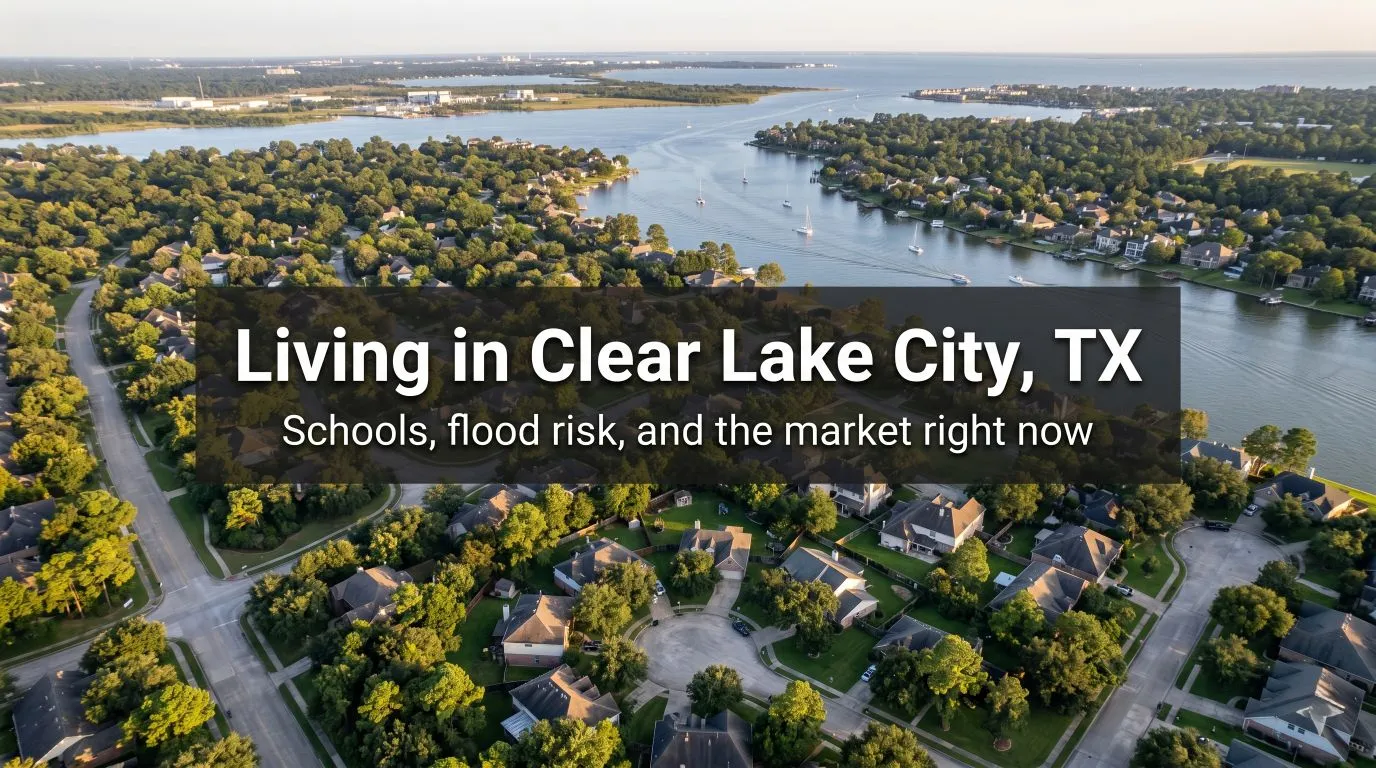
A practical guide to the schools, flood risk, housing market, and daily lifestyle that define life in Clear Lake City, the NASA-anchored heart of the Greater Houston area.
Clear Lake City is a master-planned community in the Greater Houston area built around NASA’s Johnson Space Center, spanning zip codes 77058, 77059, and 77062. The schools are strong, the employment base is nearby, and the lifestyle centers on Galveston Bay. What deserves careful attention before you buy, primarily flood risk and school zone variation, is specific to the address rather than the neighborhood.
We’ve worked the Clear Lake corridor for more than two decades, and the questions from people weighing a move here are consistent: what the schools are actually like, how much flood risk matters at a given address, and whether now is a reasonable time to buy. This guide answers each directly.
What is Clear Lake City known for?
Clear Lake City is best known for NASA’s Johnson Space Center, which has defined the community since the 1960s. The space program drew Boeing, Lockheed Martin, and dozens of aerospace subcontractors to the area, and the University of Houston-Clear Lake followed as a second anchor for education and research employment. The result is a resident base with above-average incomes and educational attainment that has held steady across multiple market cycles.
Humble Oil and Refining Company acquired the land in 1938 and, following NASA's 1961 selection of the site for its Manned Spacecraft Center, formed Friendswood Development Company as a joint venture with Del E. Webb Corporation to develop the surrounding community. Governor John Connally formally opened Clear Lake City on September 15, 1963. It spans zip codes 77058, 77059, and 77062 along the northwest shore of Galveston Bay. Established subdivisions like Bay Oaks, Bay Forest, Northfork, Pine Brook, and Brookwood carry the mature-tree, larger-lot character of communities built in the 1960s and 1970s, while newer sections in 77059 offer more recent construction for buyers who prefer it. Curious which of these five fits your budget and priorities? Our guide to Clear Lake City’s best neighborhoods compares them by price, schools, and flood risk.
Clear Lake City sits within the Greater Houston corridor alongside League City, Webster, Seabrook, and Friendswood. These communities share the same school system, the same employment base, and the same Bay-area character. When buyers compare them, they’re making a micro-market decision within one corridor, not choosing between unrelated places.
What is the housing market like in Clear Lake City right now?
The current market in the Clear Lake corridor gives buyers more breathing room than they’ve had in several years, and it asks sellers to price at current comparables rather than peak-cycle numbers.
According to the Houston Association of Realtors May 2026 Housing Market Update, released June 10, 2026:
- Median single-family sale price: $345,250, virtually unchanged year over year
- Active listings: 37,619 homes, up 2.4% year over year
- Months of inventory: 5.1, above the national 4.5 months reported by NAR
- Days on market: 54 days, up from 51 a year ago
- Pending sales: 9,172, up 5.8% year over year, the strongest new-contract activity since May 2022
More inventory and longer timelines mean buyers can evaluate homes without time pressure. The pending sales number confirms that demand is still present and active; the market is patient, not stalled.
Within Clear Lake City, a few address-level factors add nuance to the metro picture. The established subdivisions carry older housing stock, which puts more weight on condition and inspection findings than a uniformly new suburb would. Property taxes include a Harris County Flood Control District line item alongside Clear Creek ISD, and the total effective tax rate across the three zip codes typically falls between 2.2% and 2.8% of assessed value depending on the municipal utility districts and city jurisdictions that apply to the specific address. Verify the rate for any address with the Harris County Appraisal District before you finalize a budget. We’d rather walk you through current comparables for the specific streets you’re considering than quote a submarket median that may not reflect the property in front of you.
Wondering if it’s a good time to buy in Clear Lake City? See how to judge the timing.
What are the schools like in Clear Lake City?
Clear Creek ISD serves most of Clear Lake City and holds a “B” accountability rating from the Texas Education Agency (TEA, 2025). It’s a consistent draw for families relocating to the corridor, and school zone assignment is one of the sharpest pricing variables in the local market.
That second point matters more than most buyers expect. Homes zoned to the most in-demand Clear Creek campuses hold value and attract competition even when the broader market slows. Two homes a few blocks apart can carry meaningfully different sale prices and days-on-market outcomes based solely on attendance zone. Confirm the specific campus for any address you’re seriously considering, because zone lines don’t follow neighborhood boundaries reliably. A small portion of 77059 falls under Pasadena ISD rather than CCISD, per the published attendance boundaries of both districts, which is one more reason to verify before you commit. Our analysis of how school zones affect home prices and competition in Clear Lake goes deeper on how this plays out in actual transactions here.
How serious is flood risk in Clear Lake City?
Flood risk in Clear Lake City is real, varies by address, and belongs at the center of your due diligence. Two homes a block apart can fall in different FEMA zones, face different insurance requirements, and carry meaningfully different long-term ownership costs.
The community sits near Galveston Bay and spans areas both north and south of Beltway 8, which creates two distinct risk layers: rainfall flooding mapped by FEMA, and storm surge from the Bay during major storm events. FEMA zone assignments determine what flood insurance a lender will require. Zone X carries minimal mapped risk and no lender-mandated flood insurance, though in Jimmy Simien's experience working this corridor, Zone X properties here still took on water during Hurricane Harvey in 2017. Zone AE sits inside the 100-year floodplain and almost always requires lender-mandated flood insurance. Floodway properties carry the highest risk designation of all.
FEMA issued updated draft flood maps in early 2026, with a public review window before changes take effect. A zone reclassification on a property you’re buying can change both whether flood insurance is required and what it costs, which directly affects total monthly ownership expense. The Texas General Land Office maintains separate storm-surge inundation maps worth reviewing for any address south of the Beltway, independent of the FEMA zone. Is Clear Lake City in a flood zone? See which Clear Lake City flood zones matter and check any specific address against both the current FEMA designation and the draft maps before making an offer.
What is daily life like in Clear Lake City?
Daily life in Clear Lake City offers three things that rarely line up in the same community: a short commute to a major employment base, Clear Creek ISD schools within a few miles of most homes, and direct access to Galveston Bay.
The Johnson Space Center anchors the employment picture. Boeing, Lockheed Martin, and the aerospace contractors that followed NASA here mean a significant share of residents work within a few miles of where they live. The University of Houston-Clear Lake and the Bay Area medical campus along I-45 extend that employment base to people outside the aerospace sector. In our experience with clients relocating here, that's a real point of contrast with much of the rest of the Houston metro: most Clear Lake City residents who work at JSC, UHCL, or the Bay Area medical campus live just a few miles from work rather than facing a long metro-wide commute.
On weekends, the Bay is the draw. Clear Lake supports a significant concentration of recreational boats, with marinas, sailing clubs, and waterfront restaurants along the water. The Armand Bayou Nature Center, a nearly 4,000-acre urban wildlife preserve within the community following a 2024 expansion, provides a different kind of outdoor access year-round. From what we see showing homes in this corridor, the Kemah Boardwalk runs about 10 to 15 minutes south. Space Center Houston runs substantive science programming in addition to the broader visitor experience. Galveston’s beaches typically run about 45 minutes in normal traffic, a practical day trip rather than a long weekend.
Downtown Houston is roughly 25 miles up I-45, and we typically see 35 to 50 minutes depending on when you go. The pace here is suburban and water-oriented. That suits a specific kind of buyer well and isn’t for everyone, which is worth being honest about.
Who is Clear Lake City the right fit for?
Clear Lake City fits people who want a NASA-adjacent employment corridor, Clear Creek ISD schools, and Bay access, and who understand that two factors vary enough within the community to change the cost and quality of any specific purchase: the flood zone and the school attendance zone.
If you’re relocating, the two questions that matter most about any specific address are the FEMA flood zone and the Clear Creek ISD campus assignment. In Jimmy Simien’s 24 years working this corridor, those two variables explain more of the long-term value equation for a given home than anything else about the location. Clear Lake City is a strong fit for people coming to work at JSC, UHCL, or the Bay Area medical complex, who want a school district with a real track record, and who prefer an established community to a new master-planned suburb built from scratch.
If you’re buying, the current market gives you time to be thorough. Use it. Balanced inventory means you can do a proper inspection, verify flood zone and school zoning, and walk away from a property that doesn’t hold up. The older housing stock in the established subdivisions needs more inspection scrutiny than new construction does; mechanical and structural condition matter more here than in a newer community.
If you’re selling, the market will support a well-positioned, accurately priced home. Homes priced ahead of current comparables are sitting. If your property is in a lower-risk flood zone or a high-demand Clear Creek attendance zone, those are genuine differentiators that should be front and center in how the home is positioned, not buried in the listing details.
The Bottom Line
Living in Clear Lake City means choosing an established NASA-corridor community with genuine Bay-area lifestyle access, above-average schools, and an employment base close enough that many residents work within a few miles of home. The honest counterweights are an older housing stock that demands real due diligence on condition, and flood and school zone variation that is specific to the address rather than the neighborhood name. Both are manageable with the right research. The current market, with more inventory and longer timelines than the past several years, gives buyers the room to do that research properly.
If a move to Clear Lake City is on your radar, whether that’s this year or further out, we’re glad to talk through the specifics with no pressure. We can help you think through flood zone and school zoning for addresses you’re considering, current comparables, and what a realistic timeline looks like. Call our no-pressure concierge line at (281) 781-4348 or visit simienproperties.com.
References
- Houston Association of Realtors, May 2026 Housing Market Update, released June 10, 2026
- National Association of Realtors, national months-of-supply data, May 2026
- Texas Education Agency, CCISD accountability rating, 2025
- Clear Creek ISD and Pasadena ISD published attendance boundaries, accessed June 2026
- Texas State Historical Association, Handbook of Texas: Clear Lake City (founding history, Friendswood Development Company, September 15, 1963 opening)
- HoustonProperties.com, Clear Lake City neighborhood and subdivision guide, March 2026
- FEMA flood zone designations and 2026 draft flood map update, Federal Emergency Management Agency
- Texas General Land Office, storm-surge inundation maps
- Harris County Appraisal District, property tax rate data by jurisdiction, accessed June 2026
- Armand Bayou Nature Center, preserve area and program information, accessed June 2026
Get local guidance before you decide. Call our no-pressure concierge line at (281) 781-4348 or visit simienproperties.com.