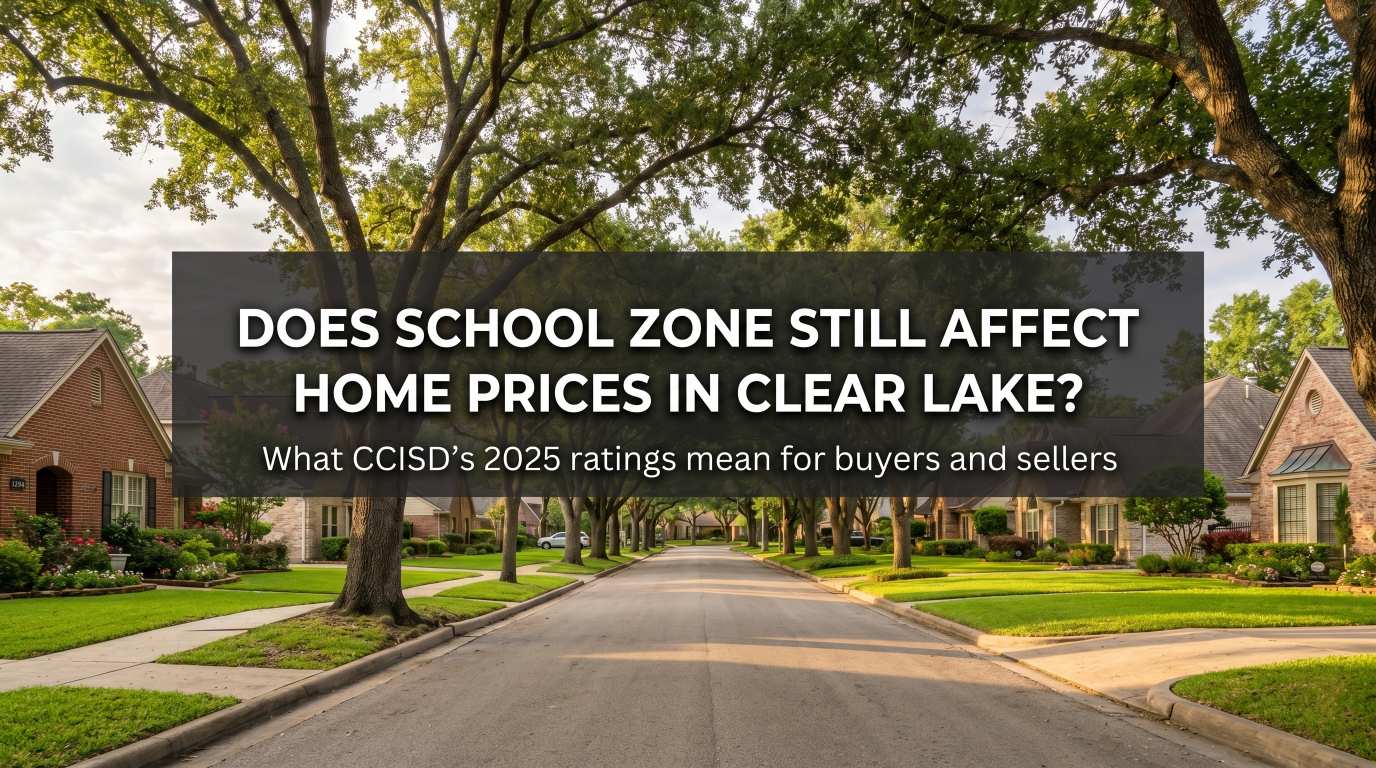
What CCISD’s improving ratings and today’s more balanced market mean for buyers and sellers in the Clear Lake corridor right now.
Yes, school zone still affects home prices and competition in Clear Lake — and in some ways it’s more visible in today’s market than it was during the peak years. CCISD zoning continues to expand your buyer pool, support your price floor, and reduce your days on market relative to comparable homes outside strong attendance zones. But the mechanism has changed. In 2021 and 2022, school zone demand was compressed into urgency, and almost any home in a desirable zone attracted multiple offers regardless of price or condition. That’s not the dynamic right now. Today, school zone works as a genuine advantage when pricing and condition are right, and a false sense of security when they aren’t.
Understanding how that plays out matters differently depending on whether you’re buying or selling. For buyers, it determines where competition is still concentrated and how much leverage you realistically have. For sellers, it determines whether your school zone is something you’re actively capitalizing on, or just assuming will do the work for you.
What does the current Clear Lake market look like for buyers and sellers?
According to the Houston Association of Realtors’ March 2026 Housing Market Update, released April 8, the broader Houston market is showing genuine spring momentum alongside continued inventory growth:
- Single-family sales rose 3.7% year over year, the first gain of 2026
- Pending sales climbed 12.8% year over year — buyers are actively moving
- Active listings: 34,898 homes, up 8.7% from a year ago
- Average days on market: 67 days, up from 62 days a year ago
- Median sale price: $330,000, down 1.5% year over year
- Months of supply: 4.7, up from 4.5 a year ago
This is a market with real buyer demand and more options than buyers have had in years. That combination creates selectivity. Buyers aren’t desperate, but they are active — and they’re using the extra time and inventory to filter more carefully. School zone is one of the most consistent filters they apply first.
Does school zone still add measurable value to a home’s price?
It does, and the research is consistent on this point. According to a 2025 market analysis from Opendoor, citing research from the National Bureau of Economic Research, homes in highly rated school districts typically command a 10% to 20% premium over comparable properties in average-performing areas. The effect is well-documented nationally and shows up consistently in Houston submarkets where district quality is a material buyer consideration.
It’s worth being precise about what that means in the Clear Lake corridor specifically. CCISD doesn’t sit at the top of Houston’s district hierarchy the way some inner-loop zones do, but it holds a meaningful and improving position in the SE Houston buyer’s calculus — and that trajectory matters.
TEA’s final 2025 accountability ratings, released December 2025 after a successful district appeal, placed CCISD at an overall score of 88, a B rating, up from 83 over the past three years. Three high schools earned A-level ratings in the updated scores:
- Clear Lake High School: 95
- Clear Springs High School: 94
- Clear Falls High School: 92
A district with improving ratings and multiple A-level high schools is a different buyer conversation than one defending a declining score. For sellers, CCISD zoning supports your price floor and gives you a buyer pool that has actively filtered for this district. That’s a real advantage. It’s not, however, a substitute for pricing correctly in a market where buyers have nearly 35,000 listings to compare.
How has buyer behavior around school zones shifted in today’s more balanced market?
School zone demand hasn’t weakened in a balanced market — it’s become more explicit. During the 2021-22 peak, the effect of school zone was often invisible to sellers because everything was moving fast regardless. In a market where homes went under contract in days, school zone was compressed into urgency alongside a dozen other factors. You couldn’t always isolate it.
At 67 days average days on market in the Houston metro (HAR, March 2026), buyers now have time to compare, research, and be deliberate. That deliberateness makes school zone a more visible decision variable. Families targeting a specific CCISD high school attendance zone aren’t browsing casually — they’re shopping with a defined filter that narrows their options and focuses their attention on a smaller set of listings. That’s the buyer pool sellers want, and they tend to be well-qualified and serious when they engage.
What’s changed is what activates that engagement. In 2021-22, being in the right zone often generated competitive offers automatically. Now, being in the right zone brings the right buyers to your door — but accurate pricing and solid condition are what convert interest into an offer. HAR’s 2026 market analysis notes that desirable homes in prime neighborhoods continue to sell competitively in the current environment, while overpriced or under-prepared properties face longer timelines regardless of location. School zone is a prime neighborhood signal, not a price override.
It’s also worth noting that school zone demand within CCISD isn’t uniform. The attendance boundaries for Clear Lake High, Clear Falls, and Clear Springs don’t create identical market conditions. Homes zoned for a campus with a 95 TEA score may see more concentrated demand than a home zoned for a lower-performing campus in the same district. Whether you’re buying or selling, knowing which specific school your address feeds matters more than knowing the district overall.
What makes the CCISD zone specifically worth understanding right now?
Three factors are converging in spring 2026 that make school zone demand in this corridor particularly relevant.
- Spring is peak school zone season. Families trying to close before the next school year are actively searching now, with a self-imposed deadline built into their timeline. That creates a motivated, self-selecting buyer pool that doesn’t exist in October or January in the same way. If you’re a seller with a CCISD-zoned home and thinking about timing, spring is when that school zone advantage concentrates most.
- The NASA/JSC employment corridor feeds a specific buyer segment. The aerospace and engineering professional community around Johnson Space Center is a consistent source of well-qualified buyers, many relocating from other markets. Relocating professionals use school ratings as one of their fastest ways to evaluate neighborhoods — they don’t have years of local context to draw on. CCISD’s improving scores and the visibility of three A-rated high schools make it an easier and more compelling conversation in 2026 than it was several years ago. We see this play out directly in how relocating buyers approach their search in this corridor.
- CCISD’s improving trajectory is a credibility signal, not just a current rating. A district moving from 83 to 88 over three years, with multiple campuses at A-level, signals direction to buyers thinking about long-term value. Parents purchasing a home where a child has years of school ahead aren’t just evaluating today’s rating — they’re evaluating the trend. That trajectory is a genuine selling point for sellers in this zone.
What does this mean if you’re buying or selling in the Clear Lake corridor?
If you’re selling, your CCISD zone is a real asset — but it’s part of a complete strategy, not a substitute for one. Price your home against the most recent closed sales in your specific attendance zone, not just your general neighborhood. Know which campus your address feeds and understand what that means for buyer demand. Document your home’s condition thoroughly, because the buyer pool CCISD attracts tends to be informed and thorough in due diligence. And list now if you’re going to — the spring window when family buyers are most active is open. Our guide on how initial pricing affects your outcome in Houston’s current inventory environment goes deeper on how to position correctly in a market like this one.
If you’re buying, understand that competition within specific CCISD attendance zones — particularly Clear Lake High, Clear Springs, and Clear Falls — is more concentrated than the overall Houston metro picture suggests. The market may be averaging 67 days on market across thousands of listings, but a well-priced, well-maintained home in a sought-after zone won’t necessarily sit that long. Go in pre-approved and with a clear picture of your must-have zone versus your flexible zone. If you’re willing to consider adjacent attendance zones with slightly lower ratings, you may find more room to negotiate without sacrificing core district quality. Our guide on how neighborhood choice affects your offer strategy in Houston covers how micro-market dynamics differ even within the same corridor.
For both buyers and sellers, the analysis starts with the specific attendance zone, not just the district overall. That’s a distinction we work through with every client in this corridor before any other decision gets made.
The Bottom Line
School zone demand is real and holding in Clear Lake. CCISD’s improving ratings and the concentration of A-level high schools give it stronger footing in 2026 than it had a few years ago. But the way that advantage works has shifted.
School zone expands your buyer pool and supports your price floor. It doesn’t override the need to price accurately and show well. For sellers, that means treating your zone as an advantage to activate, not a cushion to lean on. For buyers, it means understanding where competition concentrates within the district so you go in with the right strategy, not the wrong assumptions.
Spring 2026 is the window when school zone demand peaks. Pending sales are up 12.8% year over year (HAR, March 2026) and qualified buyers are moving. Sellers who combine CCISD zoning with accurate pricing and solid preparation are well positioned. Buyers who understand the attendance zone landscape going in will spend less time on the wrong homes.
At Simien Properties, we’ve been working in this corridor since 2002. If you want a clear read on what your specific zone means for pricing or offer strategy right now, we’re here for that conversation.
Visit simienproperties.com or call our no-pressure concierge hotline at (281) 781-4348.
References
- Houston Association of Realtors, March 2026 Housing Market Update (April 8, 2026)
- HAR.com, Are Home Prices Going Down in Houston? 2026 Housing Market Outlook
- Clear Creek Independent School District, 2025 State Accountability Ratings, TEA final ratings (December 2025)
- Texas Education Agency, 2025 A-F Accountability Ratings (August 2025, updated December 2025)
- Opendoor, School Quality and Home Prices: 2025 Market Analysis
- National Bureau of Economic Research, school expenditure and home value correlation research