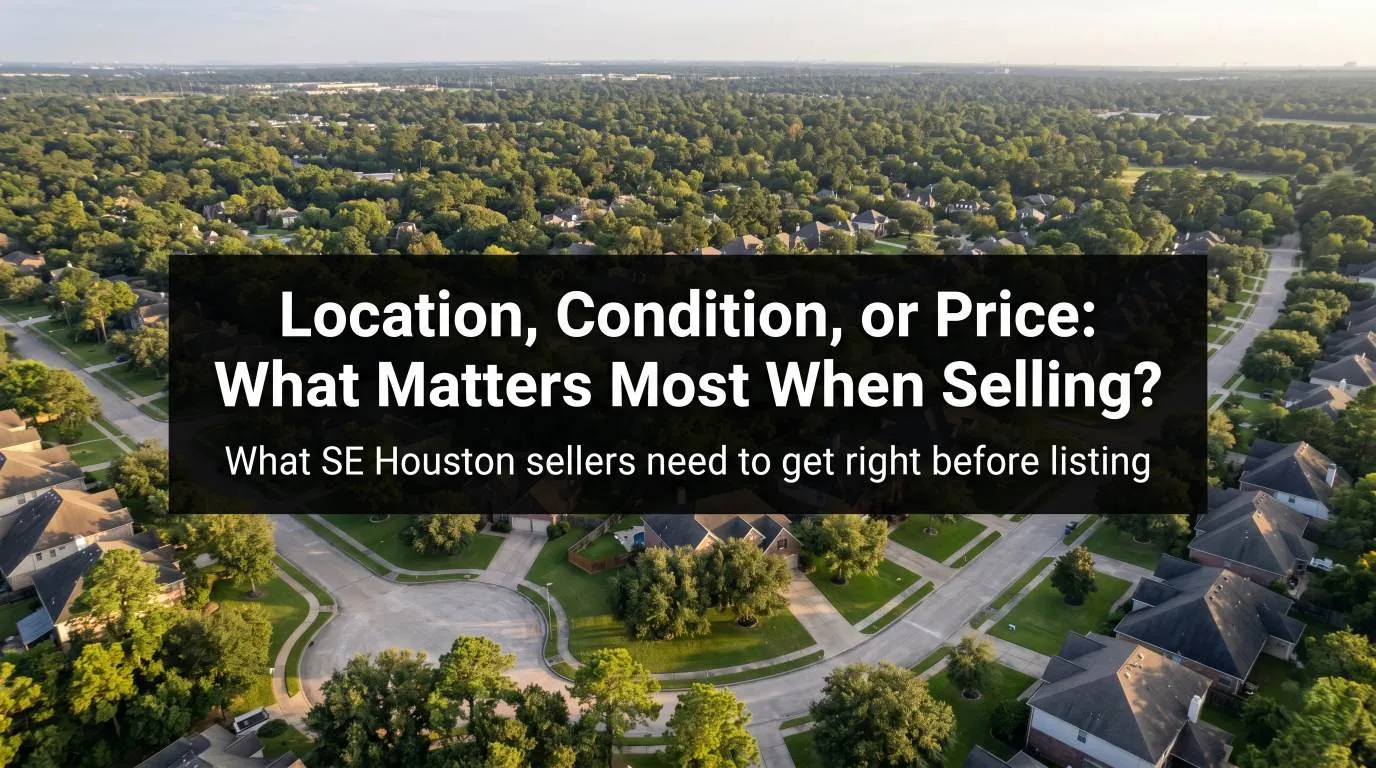
The answer depends on how these three factors interact in today’s Clear Lake corridor market, and which one carries the most risk if you get it wrong.
If you’re selling in Clear Lake, League City, Friendswood, or Webster and need a direct answer: initial pricing carries the most risk of any decision you’ll make, but location and condition determine how much pricing flexibility you actually have. These three factors don’t work independently. Location sets your ceiling. Condition determines how close to that ceiling you can price. And pricing determines whether buyers act during the window that matters most.
Getting the sequence wrong is the most common reason well-prepared homes sit longer than they should. Here’s how each factor plays out in today’s Greater Houston market, and what to do with that before you list.
What’s the Current Market Condition for Greater Houston Sellers?
According to the Houston Association of Realtors’ March 2026 Housing Market Update, released April 8, 2026:
- Single-family home sales rose 3.7% year over year, the first gain of 2026, with 7,644 homes sold
- Pending sales climbed 12.8% year over year, a strong indicator of spring buyer demand building
- Active listings: 34,898 homes, up 8.7% year over year
- Average days on market: 67 days, up from 62 days a year ago
- Median sale price: $330,000, down 1.5% year over year
- Months of supply: 4.7, up from 4.5 a year ago
Buyer demand is genuine, as the pending sales numbers confirm. But with inventory up nearly 9% year over year and days on market climbing to 67, up from 62 a year ago, buyers have more options and more time to use them. That directly affects how location, condition, and pricing each perform.
How Does Location Affect Your Sale in the Greater Houston Market?
Location doesn’t make your home easy or hard to sell on its own. What it does is define your buyer pool and place a ceiling on what pricing and condition efforts can realistically achieve. In the Clear Lake corridor, a few specific location factors carry more weight than sellers often account for when setting expectations.
Flood zone designation is the most consequential in this market. Whether your home sits within a FEMA Special Flood Hazard Area affects buyer pool size, the insurance quotes buyers receive early in their search, and what lenders require before approving financing. It’s not a disqualifier, but it needs to be priced for upfront rather than surfacing as a surprise during inspection or underwriting.
Beyond flood exposure, the location factors that consistently move the needle in this corridor are:
- School district. Clear Creek ISD attendance zones carry measurable value. Many buyers in this corridor filter by school district before they settle on a price range.
- Proximity to NASA/JSC. The aerospace and engineering professional community is a specific, well-qualified buyer segment. Homes within a practical commute of Johnson Space Center attract a steadier pool of serious buyers.
- Deed-restricted vs. non-restricted. In our experience working this corridor, deed-restricted communities command a consistent premium over non-restricted alternatives at similar price points, and that gap holds even in a more balanced market.
When location is strong, you have more room to price confidently and more tolerance for minor condition issues. When location presents real challenges, sharper pricing and tighter condition preparation become more important, not less.
Does Home Condition Matter More to Buyers Now Than It Did a Few Years Ago?
Yes, and the reason is specific to where the market is today. When homes in the Greater Houston area were selling in two to three weeks with competing offers, buyers made concessions they wouldn’t otherwise accept. They waived inspections, absorbed deferred maintenance, and looked past problems because limited inventory left them with little choice. At 67 days average days on market (HAR, March 2026), that dynamic is gone. Buyers now have time for a thorough inspection, a second opinion, and a renegotiation based on what they find. Most are using that time.
In the Greater Houston area, the condition issues generating the most friction at inspection right now tend to be mechanical and structural rather than cosmetic:
- HVAC age and current condition
- Roof remaining life and the history of any recent repairs
- Foundation performance, a genuine local concern given Houston’s expansive clay soil
- Water intrusion history and documentation of how it was addressed
- Post-flood remediation records, elevation certificates, and current insurance information
That last category is specific to this corridor. Buyers shopping in Clear Lake and surrounding communities ask about flood history as a standard part of their due diligence, and sellers who have that documentation organized move through the process faster and with fewer surprises.
The practical standard to apply before listing: if a buyer’s inspector is likely to flag it, address it, price for it, or disclose it proactively. Renegotiations that happen after a contract is signed almost always cost more than dealing with the issue beforehand would have.
Why Does Initial Pricing Carry the Most Risk, and What Does Getting It Wrong Actually Cost?
The most common seller mistake in this market isn’t simply overpricing. It’s anchoring to a market that no longer exists. A neighbor’s sale from 2022, an automated estimate that lagged reality, a memory of when almost any well-maintained home attracted urgency. Buyers aren’t shopping in that market. They’re comparing your listing to what’s available today, in your price band, in your specific neighborhood, with more time and information than they’ve had in years.
The first two to three weeks after your listing hits the MLS are when it gets the most buyer attention. A home priced correctly generates showings and offers in that window. One priced above where buyers will act generates silence, and silence compounds quickly. Days accumulate, buyers assume something is wrong, and even after a price reduction the perception of a stale listing lingers through negotiations. You end up negotiating from a weaker position than if you’d priced accurately from day one.
The Texas Real Estate Research Center’s March 2026 Housing Insight report puts the broader trend in context. Statewide, sellers cut list prices further and more often in early 2026 than they did the year before, and Houston’s average concessions have held up better than markets like Austin or San Antonio. That direction is consistent with what we see across the Greater Houston area: sellers who reduce and negotiate down tend to net less than those who priced accurately and sold in the first month.
A few things specific to the Greater Houston area price range are worth knowing before you set a number:
- The $250,000 to $499,999 range covers most of this corridor and is where resale homes compete most directly with new construction builder incentives. HAR’s February 2026 data, the most recent with segment-level detail, flagged this band as seeing the most softness of any price segment.
- March’s broader sales recovery is encouraging, but it’s rewarding sellers priced for today’s market, not those working from older expectations.
- Affordability has improved. HAR’s March 2026 data shows the typical Houston buyer’s monthly payment is about $106 less than a year ago. More qualified buyers are entering the market, but they’re comparing multiple listings at once. The home that’s clearly well-priced captures their attention. The one that requires justification gets passed over.
How Should Sellers in Clear Lake and the Greater Houston Area Approach All Three Factors Together?
Work through them in sequence: location first, then condition, then price. That order matters because each step genuinely informs the next. Location calibrates your pricing ceiling, condition determines how much of that ceiling you can capture, and price determines whether buyers act during the window that matters most.
- Start with an honest read on your location. Understand what your flood zone status, school district, and neighborhood demand profile mean for your buyer pool. This calibrates your pricing ceiling before any other decision gets made. We go through this specifically with sellers in Clear Lake and surrounding communities first, because location shapes every downstream choice.
- Then address the condition issues that cost you deals, not every item on the list. Focus on what a buyer’s inspector will flag and what buyers at your price point walk away from. Cosmetic updates help at the margin but rarely return their full cost in this market. Getting the mechanical issues and documentation right matters more.
- Finally, price for where the market is today. Closed sales from the last 60 to 90 days in your specific submarket are the only reliable anchor. Active listings show you what you’re competing against right now. Your price needs to make sense within that live comparison set, not against what sold at a different point in the cycle.
The Bottom Line
Location, condition, and pricing aren’t a ranking where you pick one and set the others aside. They work as a system. Location sets what’s possible. Condition determines how much of that potential you’re able to capture. Pricing determines whether the right buyers act during the window when your listing has its strongest chance.
Spring 2026 has real buyer demand behind it. Pending sales are up 12.8% year over year, and improving affordability is bringing more qualified buyers back into the market. Sellers who have a clear-eyed read on all three variables are well positioned to move confidently and protect their proceeds. Sellers still pricing to a market that shifted two or three years ago are the ones accounting for the majority of those widening price cuts.
At Simien Properties, we work with sellers across Clear Lake, League City, Friendswood, Webster, and surrounding communities to get this right before going to market. That means a read on your specific neighborhood and what buyers in your submarket are actually doing right now, not just Houston-wide averages.
Visit simienproperties.com or call our no-pressure concierge hotline at (281) 781-4348 to talk through where your home stands before you decide.
Buyers weigh these same three factors from the other side, something we cover in how buyers prioritize price, location, and condition, useful context for how to position your listing. Our seller’s guide (opens in a new tab) covers the rest.
References
- Houston Association of Realtors, March 2026 Housing Market Update (April 8, 2026)
- Houston Association of Realtors, February 2026 Housing Market Update (March 11, 2026), segment-level pricing data
- Texas Real Estate Research Center, Texas Housing Insight March 2026
Get local guidance before you decide. Call our no-pressure concierge line at (281) 781-4348 or visit simienproperties.com.