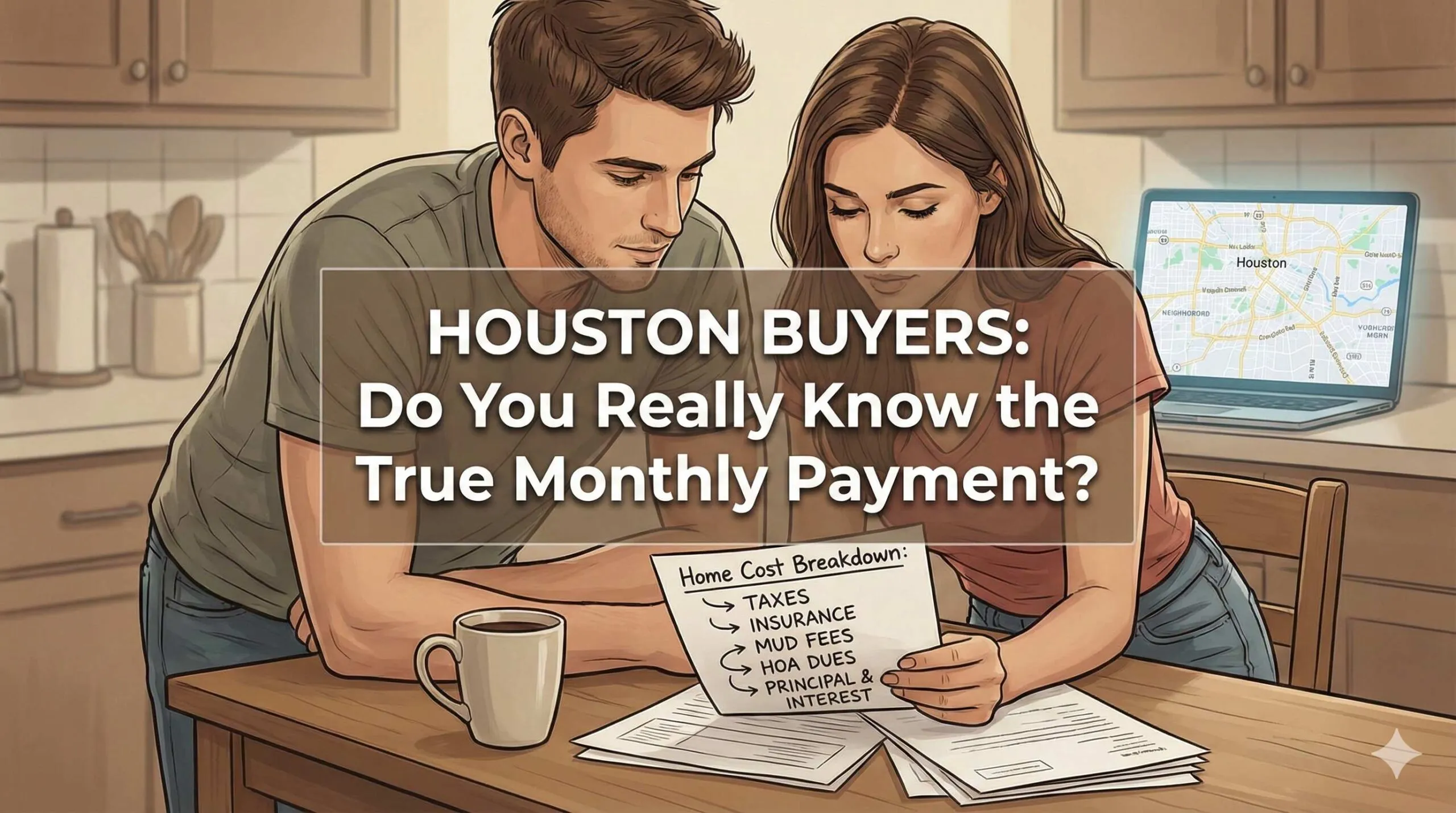
Most buyers begin their home search with a number in mind, a comfortable monthly payment they build their plans around. They plug a home price and interest rate into a mortgage calculator, see the result, and assume they’re ready. But in Houston, that payment estimate is rarely accurate. Our market has layers most calculators never account for, and those layers can change the true monthly cost by hundreds of dollars.
Houston buyers routinely overlook major factors like property taxes, insurance, MUD rates, HOA dues, flood risk, utilities, and future maintenance. And when buyers discover those expenses after falling in love with a home, it often forces a budget reset they didn’t expect.
The goal of this guide is simple: make sure Houston buyers understand the full picture long before they’re under contract, so nothing catches them off guard.
Why Monthly Payments Are More Complicated in Houston
Texas has no state income tax, so Houston-area cities, counties and school districts fund services through property taxes instead. That single fact is why the ongoing cost of owning a Houston home runs higher than its list price suggests, and it is where most budget surprises start.
How Much Are Property Taxes in the Houston Area?
Effective property tax rates in the Houston area generally run between 1.6% and 2.5% of a home’s assessed value, well above the national average. Houston is one of the most affordable major metros in the country on list price, but the ongoing costs of ownership tell a different story. U.S. Census Bureau American Community Survey data puts Harris County’s typical effective rate around 1.6%–1.7%, while HAR’s own reporting on Houston-area MUD districts shows newer suburban developments with recently issued bonds carrying combined rates closer to 2.5% before those bonds are paid down. That alone can swing a monthly payment far more than a small change in mortgage rate.
What Is a MUD Tax, and How Much Does It Add?
A Municipal Utility District, or MUD, is a separate taxing entity that funds roads, drainage, water and sewer in a developing community, and it adds its own line to your tax bill on top of city, county and school district rates. Newer communities in Katy, Cypress, Richmond, Pearland, and Spring are commonly built inside one. These districts add a separate tax line that buyers often don’t see until late in the process. A home in a high-MUD-rate community can carry a much larger monthly cost than a similar home in an older neighborhood with a more modest tax burden.
Insurance is another major factor buyers underestimate. Houston’s exposure to hurricanes, flooding, and rising construction costs has pushed premiums significantly higher over the past several years. It’s now common for a Houston-area quote to land in the $4,000–$6,000 range per year, depending on the age of the roof, type of foundation, and proximity to waterways. That is higher than the county-wide average, which includes many older and lower-value homes: Texas Department of Insurance data, analyzed by Rice University’s Kinder Institute for Urban Research, puts the Harris County-wide average premium at roughly $3,325 as of 2023, up 43% since 2015. That’s a different measure (a TDI-filed rate average) than the Census Bureau’s self-reported median, which the Kinder Institute separately found rose about 17% in Harris County during 2024 (from roughly $1,970 to $2,300), so don’t read the two figures as one continuous line. Statewide, Texas Department of Insurance rate filings show homeowners rates climbed roughly 19% that same year. Premiums run considerably higher in the waterfront and higher-value neighborhoods Simien Properties typically serves, where average premiums commonly run $5,000–$9,500. For many buyers, that’s a $300–$500 monthly cost they didn’t anticipate.
Flood insurance adds another layer. A far larger share of Harris County flood damage happens outside the mapped high-risk zones than most buyers assume. A 2018 Harris County analysis found roughly three-quarters of homes that flooded during Hurricane Harvey sat outside the 100-year floodplain, and a longer-term study of the three decades before Harvey put the outside-the-floodplain share of flood damage claims at about 47%. That real gap between the FEMA map and where flooding actually occurs is why many buyers decide to purchase a policy for peace of mind even when lenders don’t require it.
And that’s before considering HOA dues, utility usage during 100-degree summers, and the maintenance costs of larger homes with older systems.
All of this is why two homes priced the same can differ by several hundred dollars per month, and why monthly payment clarity makes such a difference for Houston buyers.
The Five Costs Buyers Miss Most (and Why They Matter)
These are the areas where buyers experience the biggest surprises, and the ones that shift affordability once the full numbers are on the table.
1. Property Taxes
Property taxes are the biggest driver of escrow payments in Houston, and the rates vary dramatically by neighborhood, county, and school district. A half-percent difference in tax rate on a $400,000 home can easily add $150–$200 to the monthly payment. For buyers focusing only on mortgage principal and interest, this single variable reshapes affordability more than almost anything else.
2. MUD and PID Taxes
Houston’s MUD structure is unique compared to most cities. These districts fund roads, drainage, water, and sewage infrastructure in developing areas. The tradeoff is a higher tax rate that lasts for years. A home with a high MUD tax may look affordable in photos but can carry a meaningfully larger escrow payment once taxes are factored in.
3. Homeowners Insurance
Insurance premiums in the Houston region have climbed sharply. Storm exposure, roof age, and replacement-cost increases all contribute to higher annual premiums. For many buyers, the difference between estimated insurance and actual quotes can add hundreds to their monthly cost. Obtaining real insurance estimates early in the search prevents that last-minute surprise.
4. Flood Insurance
Even when a home isn’t in a mapped flood zone, many buyers still choose coverage because of Houston’s history with major storms. Flood insurance varies by elevation, foundation type, and property characteristics, and in many cases runs $500–$1,500 per year. For context, the average annual National Flood Insurance Program premium in Harris County sits in the $790 to $930 range across roughly 262,000 active policies, with lower-risk properties averaging less. It’s a manageable cost, but still one that should be included in monthly planning.
5. HOA Dues, Utilities, and Home Maintenance
HOA dues swing widely depending on what a neighborhood actually maintains. HAR’s own breakdown of Houston-area homebuying costs puts typical dues at roughly $300–$1,500 per year for standard neighborhoods, which works out to about $25–$125 a month, with golf-course and other high-amenity communities running $3,000–$10,000 per year or more, or several hundred dollars a month. Electricity bills can vary widely between homes built in the 1980s and new energy-efficient construction. And big-ticket items like roof replacement, AC repairs, and plumbing work become more likely as homes age. Most buyers don’t factor these into their monthly budget, but they significantly influence long-term affordability.
Why This Matters for Buyers Heading Into 2026
Houston’s market remains healthy, but the factors that influence monthly payments continue to evolve. Insurance premiums have risen statewide. Property taxes in many areas are reassessed upward as home values grow. Utility costs fluctuate with heat waves. And rapid growth in suburban communities means more homes carrying MUD or PID taxes.
At the same time, mortgage rates have climbed. Freddie Mac’s average 30-year fixed rate was 7.28% on October 1, 2026, up from 6.34% a year earlier, so every part of the payment counts for more. Buyers who fully understand all the other components of their payment are the ones who can plan around it.
Therefore, affordability in 2026 shouldn’t simply be about what the bank will approve. It’s about what fits comfortably into a buyer’s real-life monthly budget. Buyers who look at the whole picture make stronger decisions, feel more confident during the purchase process, and position themselves for long-term financial comfort.
Final Thought: Your True Monthly Payment Is More Than a Calculator
Houston is a city where price alone doesn’t tell the whole story. The real monthly payment, the one that determines comfort, confidence, and long-term stability, is shaped by taxes, insurance, MUD rates, utilities, and maintenance.
Understanding these numbers early doesn’t complicate the process. It simplifies it. And it empowers buyers to compare homes accurately, choose neighborhoods that align with their real budget, and move forward without surprise expenses waiting on the other side of closing. If a seller offers help with closing costs, our guide on whether a rate buydown beats a price reduction shows how that credit can lower the payment itself.
If you want help breaking down the full monthly cost of homes in the areas you’re considering, or want a side-by-side comparison of neighborhoods, your Simien Properties concierge is always here to help. Call our hotline anytime at (281) 781-4348 or visit SimienProperties.com.
Getting your real monthly number right is one piece of the process. Our first-time buyer’s guide walks through the rest, and choosing a quality lender is worth a look before you shop for one. Our buyer’s guide (opens in a new tab) ties it all together.
References
- U.S. Census Bureau, American Community Survey, Harris County effective property tax rate data
- HAR.com, Houston MUD tax and property tax explainer reporting
- Texas Department of Insurance homeowners insurance premium and rate-filing data, as analyzed by Rice University’s Kinder Institute for Urban Research
- Rice University’s Kinder Institute for Urban Research, Harris County median homeowners insurance premium analysis (U.S. Census Bureau American Community Survey data), 2024
- Harris County post-Harvey flood-damage analysis (2018), as reported by the Houston Chronicle
- Highfield et al., three-decade study of Greater Houston flood-damage claims outside the 100-year floodplain, as reported by Rice University’s Kinder Institute for Urban Research
- HAR.com, “Understanding the Additional Costs of Buying a Home in Houston”
- FEMA National Flood Insurance Program policy and premium data for Harris County, Texas
- Freddie Mac, Primary Mortgage Market Survey, weekly average as of October 1, 2026
Get local guidance before you decide. Call our no-pressure concierge line at (281) 781-4348 or visit simienproperties.com.