If you’re buying a home in Houston right now, you’ve probably done what most smart buyers do:
You’ve checked the neighborhood. Looked at school zones. Compared prices. Watched interest rates. Maybe even toured a handful of homes and started building a shortlist.
And then you get to the part that feels harder to quantify:
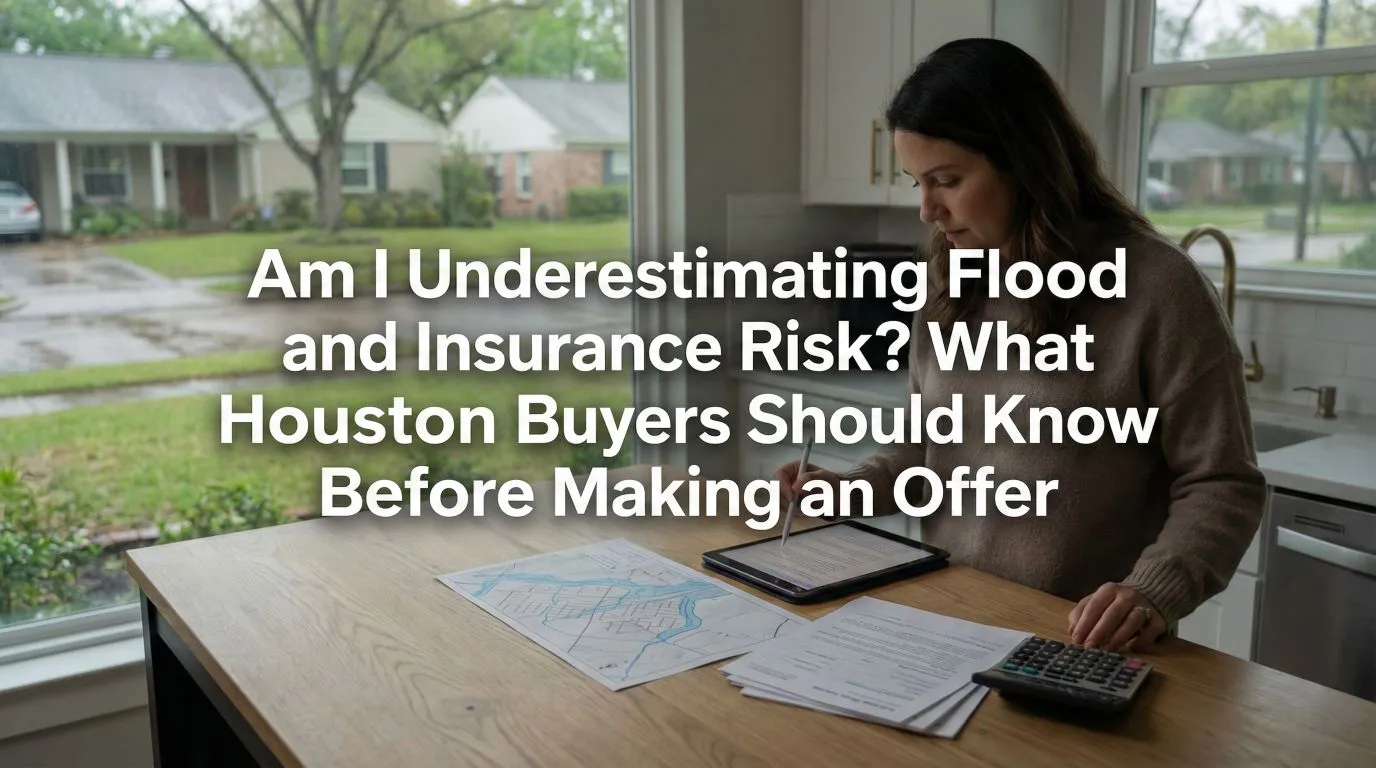
Flood risk. Insurance risk. And the uncomfortable question behind both: Am I missing something that’s going to hit me later, financially or emotionally?
Because “risk” in Houston rarely shows up as one obvious red flag. It shows up as payment volatility, surprise costs, and a slow realization that two homes at the same price can carry very different long-term realities.
This article is here to give you just enough context to be informed, and a simple path to take action without spiraling.
Does Being Outside a Mapped Flood Zone Mean a Houston Home Is Safe From Flooding?
No. Many buyers still think flood risk works like a light switch (flood zone means risky, not in a flood zone means safe), but Houston doesn't behave like that.
In practice, Houston flood experience is shaped by a stack of factors: bayous and creeks, rainfall patterns, drainage capacity, street design, elevation, nearby development, and even how water moves through a neighborhood.
A home can be outside a mapped floodplain and still face a real flooding concern, especially from heavy rainfall and localized drainage issues. At the same time, mapped floodplains do matter because they can affect lender requirements, buyer perception, and insurance decisions.
And here’s what makes this topic even more relevant right now: Flood mapping is still evolving. In Harris County, FEMA-related mapping work and draft updates have drawn attention because the effective floodplain footprint can change over time, meaning a home that “feels safe today” may face different regulatory or insurance implications later (Harris County Flood Control District).
Why Has Insurance Become a Monthly Payment Variable for Houston Buyers?
This is the part many buyers underestimate the most: Even if you’re confident about the home and the location, the impact of insurance can change the math, sometimes dramatically.
Texas has experienced significant homeowners insurance increases in recent years. The Texas Department of Insurance’s reporting notes homeowners rates rose on average about 21.1% in 2023 (Texas Department of Insurance), and reporting citing TDI indicates rates climbed by nearly 19% in 2024 (The Texas Tribune). That matters because buyers are increasingly payment focused. A home that looks affordable on paper can feel different once insurance quotes come in, and it’s one reason buyers are more cautious than they were a few years ago.
It’s also important to note that insurers don’t price risk uniformly across Houston. Two neighborhoods can produce very different quotes, even for similar homes, because insurers weigh things like roof age/type, claim patterns, replacement cost trends, and their own appetite for certain areas.
Because of this, Texas regulators have urged homeowners to shop coverage (and note alternatives when coverage is hard to find). That’s a real signal that the market is shifting and buyers should treat insurance as a proactive step, not an afterthought (Texas Department of Insurance).
Do You Still Need Flood Insurance If a Home Is Not in a Flood Zone?
Even if you’re not required to buy flood insurance, you still need to understand what you’re opting out of.
FEMA maintains flood maps as a public tool for identifying higher-risk areas (FEMA). But flood insurance pricing is no longer purely “zone-based.” FEMA’s NFIP uses Risk Rating 2.0, a more individualized approach that considers property-specific risk characteristics. FEMA notes Risk Rating 2.0 is fully implemented (as of April 1, 2023) as the program’s pricing approach (FEMA).
What that means in plain English:
- Two homes in the same broad area may not have the same flood insurance cost.
- “Zone X” isn’t a guaranteed shield from risk or future cost changes.
- The real question isn’t “Is it required?”
It’s “Is it worth it for my risk tolerance and budget predictability?”
How Can You Get Clarity on a Home's Flood and Insurance Risk Before You Make an Offer?
Run through a six-step checklist: check FEMA's flood maps, cross-check them against Harris County's local flood tools, ask the seller property-specific risk questions, get insurance quotes early, stress-test your budget against a high insurance quote, and decide your own risk tolerance before you write the offer. Here's how Houston buyers avoid surprises using each step.
1) Start with FEMA flood maps (baseline)
Use FEMA’s flood maps as your first lens. It’s not the only tool, but it’s the standard baseline (FEMA).
2) Cross-check local flood tools (Houston/Harris County context)
Houston-area buyers should go one step deeper and use Harris County’s Flood Education Mapping Tool (FEMT), which explains mapped floodplains and floodways in a very readable way (harriscountyfemt.org).
Harris County Flood Control District also maintains interactive mapping resources to help residents understand local flood context (hcfcd.org).
Why this matters: local tools often help you interpret what the FEMA layer actually means in real-world terms.
3) Ask property-specific questions that reveal real risk
Not fear-based questions, but real ones:
- Has the property ever flooded? (disclosures and conversation)
- Are there visible drainage issues after heavy rain?
- Any history of water intrusion or foundation repairs?
- Is an elevation certificate available (if relevant)?
- What does the neighborhood look like after big storms?
This is where you stop relying on generalizations and start learning this home’s story.
4) Get insurance quotes early, before your option window closes
This is one of the most practical moves a Houston buyer can make. Don’t wait until the end to “see what insurance will be.” Instead:
- Get multiple quotes early
- Ask about deductible structure
- Confirm wind/hail considerations
- Understand what’s excluded, limited, or conditional
Texas insurers and regulators have emphasized shopping and awareness as premiums rise, which supports making this a core step, not a footnote (Texas Department of Insurance).
5) Run a “payment stability” test
Instead of assuming one number, model 3 scenarios:
- Low insurance quote
- Medium
- High
If the high number breaks your comfort level, that home may still be a great home, but it becomes a different decision. This is how buyers protect themselves from “payment shock.”
6) Decide your personal risk rule
Ask yourself:
- What level of payment variability can I tolerate?
- Would I rather pay a bit more for predictability, or take on more uncertainty for a better location/price?
- If this home had an unexpected $5–10k issue, would I be okay?
There’s no “right” answer here. There’s only the answer that matches your life.
The Bottom Line for Houston Buyers
You’re not paranoid for thinking about flood and insurance risk. In Houston, it’s part of buying responsibly.
The mistake homebuyers make isn’t buying a home with some level of risk, because every home has tradeoffs. The mistake is buying without understanding how that risk could affect the monthly payment, comfort living there, and the options later if you need to sell.
If you want help walking through insurance and risk clearly (flood maps, insurance quotes, neighborhood context, and payment scenarios), this is exactly what we do.
At Simien Properties, our concierge approach helps buyers make confident decisions without fear-based guessing. If you want a calm second set of eyes, visit simienproperties.com or call our no-pressure concierge hotline at (281) 781-4348.
If Clear Lake City is on your list, our guide to flood zones in Clear Lake City breaks down what to check before you write an offer, and our buyer’s guide (opens in a new tab) covers the rest of the process.
References
- FEMA Flood Maps overview (FEMA)
- FEMA NFIP Risk Rating 2.0 pricing approach + fact sheet (FEMA)
- Harris County Flood Education Mapping Tool (FEMT) + tool description (harriscountyfemt.org)
- Harris County Flood Control District interactive mapping resources (hcfcd.org)
- Texas Department of Insurance 2024 Biennial Report (homeowners rate increase reference) (Texas Department of Insurance)
- Texas Tribune reporting citing TDI: homeowners’ insurance rates climbed nearly 19% in 2024 (The Texas Tribune)
- Texas Department of Insurance consumer guidance on shopping / coverage challenges (Texas Department of Insurance)
Get local guidance before you decide. Call our no-pressure concierge line at (281) 781-4348 or visit simienproperties.com.