If you’re thinking about selling in Houston, you’ve probably heard it: “Wait until spring.”
For years, that advice made sense. Warmer weather, buyers planning moves before the school year, more buyer traffic, and spring historically meant momentum.
But Houston in 2025–2026 is not Houston in 2019. Inventory has normalized, days on market have lengthened, and buyers are more analytical. So the real question isn’t whether spring or seasonality in general is historically strong.
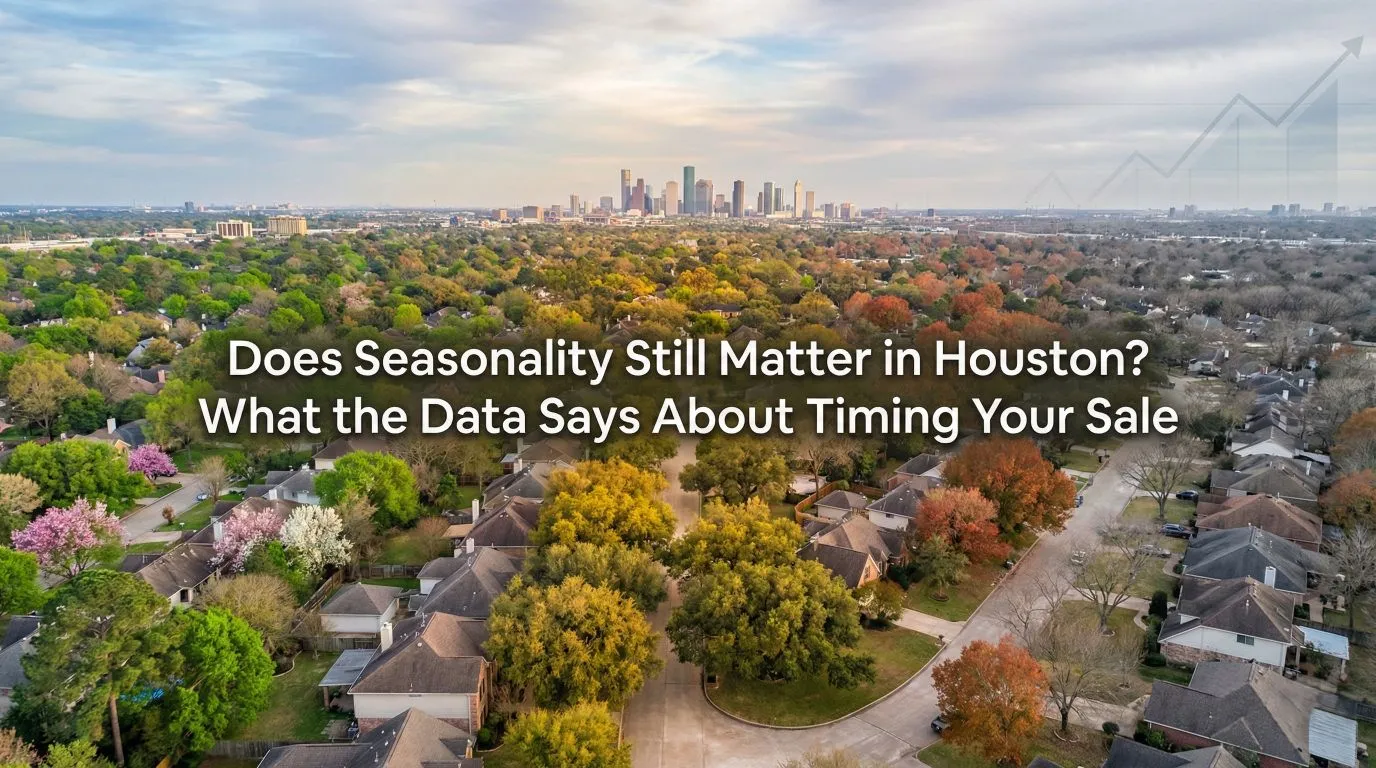
The question becomes this: Does seasonality still meaningfully impact the outcome, or is strategy now more important than the calendar?
Let’s look at what the data actually shows.
What Traditional Seasonality Looks Like in Houston
Historically, Houston follows a predictable seasonal rhythm. The Houston Association of Realtors (HAR) has long reported that March through May typically bring increases in listings and buyer activity, with strong momentum often extending into early summer. HAR market commentary consistently notes spring as the most active period for showings and new listings (HAR, Market Updates).
National data supports this broader pattern. The National Association of Realtors (NAR) has consistently found that homes listed in late spring and early summer often sell faster and sometimes at stronger prices compared to winter months (National Association of Realtors, Existing Home Sales Data).
The underlying reasons are familiar to anyone who watches housing markets over time. Seasonal rhythms track weather, school calendars, and the times of year households are most able to move.
Academic work points the same direction. A 2025 study of U.S. housing data from 1991 to 2024 (Hu, Huang, and Wang, arXiv preprint) confirmed that seasonal fluctuations in both prices and sales volumes persist, found that the annual peak has shifted earlier since the pandemic, toward March and April, and found that regional variation tracks differences in climate and market structure.
So yes, seasonality exists. But existence doesn’t mean it dominates the market like it used to.
What Has Changed in Houston’s Current Market
Recent Houston data shows that homes are taking longer to sell than in prior peak years. Reporting in the Houston Chronicle highlighted that early 2026 average days on market reached the mid-60s, which is among the longest in several years (Houston Chronicle, Houston Housing Market Slowdown).
At the same time, HAR data shows inventory levels have moved closer to balanced territory compared to the ultra-tight conditions of 2021–2022 (HAR MLS Department Data).
In practical terms, this means:
- Buyers have more choices.
- Sellers have more competition.
- Urgency is lower.
- Price sensitivity is higher.
In a more balanced market like this, spring traffic alone does not guarantee strong offers. More listings in spring also mean more competition, and balanced markets soften seasonal spikes. The calendar matters, but less than it used to when demand dramatically outpaced supply.
Where Seasonality Still Helps (and Where It Doesn’t)
Seasonality still influences behavior in Houston, but it works differently now.
Where it can help:
- Spring and early summer still bring higher listing volume and buyer activity.
- Buyers relocating for work or school still prefer summer closings.
- Longer daylight hours often increase showing flexibility.
Where it doesn’t control outcomes:
- Pricing accuracy matters more than month.
- Presentation and preparation matter more than timing.
- Neighborhood-level demand patterns often override broad seasonal trends.
For example, a well-prepared, competitively priced home in October may outperform an overpriced home in April.
In today’s Houston market, exposure doesn’t equal leverage. You can have more showings in spring, but if buyers perceive better alternatives nearby, you don’t automatically gain advantage.
What Actually Moves the Needle in 2026
If season alone doesn’t determine outcome, what does? Based on current Houston market behavior, five factors carry more weight than the calendar:
1. Pricing Within Your Segment
Buyers today are payment-focused and comparison-driven. Overpricing early in a balanced market can cost more than listing in the “wrong” season.
2. Condition and Presentation
Move-in-ready homes continue to perform better across all seasons. Deferred maintenance stands out more when buyers have options.
3. Inventory in Your Micro-Market
Houston is not one market. Certain neighborhoods or price bands may still move quickly while others move slowly, regardless of month.
4. Buyer Confidence
Mortgage rates shape what buyers can afford month to month, and Freddie Mac’s Primary Mortgage Market Survey is the weekly benchmark most buyers and lenders watch. In our experience, when rates hold steady for a stretch, buyer activity tends to pick up regardless of what the calendar says.
5. Seller Readiness
Sellers who prepare early (e.g., repairs, staging, pricing strategy) often outperform sellers who simply “wait for spring.”
In short: Preparation and precision now outweigh timing alone.
How Smart Houston Sellers Should Think About Timing
Instead of asking, “Is this the right season?” a better question is: “Am I positioned correctly for the conditions right now?”
Here’s a practical framework sellers can use:
- Evaluate your goals first. Are you tied to a school calendar, job relocation, or purchase timeline?
- Analyze current competition. How many similar homes are active in your neighborhood?
- Stress-test your pricing strategy. What happens if you list 3% too high in this market?
- Prepare before you list. Repairs, updates, and staging can amplify any seasonal window.
- Use season as an accelerator, not a crutch.
If spring aligns with your readiness and goals, it can absolutely help. If not, a strong strategy in fall or winter can outperform a weak spring launch.
Bottom Line for Houston Sellers
Seasonality in Houston still exists. Spring historically brings activity, and summer continues to attract moves timed to the school calendar. But in today’s balanced, more analytical market, season does not override strategy. However, calendar timing still has a strong influence on overall traffic.
If you’re considering selling and wondering whether to wait for a “better season,” the more important conversation may be:
- How does my home fit into today’s micro-market?
- What leverage do I actually have right now?
- What would improve my position more: waiting, or preparing?
At Simien Properties, our concierge approach is built to answer those questions with clarity, not pressure. We analyze neighborhood level demand, inventory trends, pricing bands, and your personal timeline to determine whether timing is helping or just delaying a decision.
Visit simienproperties.com or call our no-pressure concierge hotline at (281) 781-4348 to create a plan tailored to your home and your goals.
Timing is only one piece of a strong listing strategy. Pair this with what actually controls how long your home sits on the market, and see our seller’s guide (opens in a new tab) for the full picture.
References
- Houston Association of Realtors (HAR), MLS Market Updates & Inventory Data
https://www.har.com/content/department/mls - National Association of Realtors (NAR), Existing Home Sales Reports & Research Data
https://www.nar.realtor/research-and-statistics - Houston Chronicle, Houston Housing Market Slowdown Coverage
https://www.chron.com/news/houston-texas/article/houston-housing-market-slow-21348123.php - Freddie Mac, Primary Mortgage Market Survey (PMMS)
https://www.freddiemac.com/pmms - Hu, Huang & Wang, "Seasonality in the U.S. Housing Market: Post-Pandemic Shifts and Regional Dynamics," arXiv preprint 2511.10808, November 2025
https://arxiv.org/abs/2511.10808
Data reflects Houston-area market conditions through 2025–2026. Local results vary by neighborhood, price range, and property condition.
Get local guidance before you decide. Call our no-pressure concierge line at (281) 781-4348 or visit simienproperties.com.