
Ask Jimmy
A Live Q&A on Houston Real Estate
Ask Jimmy is a recurring Q&A where you send in a real estate question, about buying, selling, the market, or construction, and Jimmy Simien answers it directly, with no script.
It runs two ways: a weekly Q&A where Jimmy and Joe answer a question or two in a short segment, and a monthly live roundtable where up to 20 people join a video call and ask questions directly. You can send a question ahead of time or ask it live.
RSVP or Send Jimmy Your Question
Limited to 20 seats. Miss it? It joins the library below.
Ask Jimmy, by the Numbers
Two Ways to Participate
Ask Jimmy runs on two formats. You can follow one or both.
Weekly Q&A
Each episode is a short audio-and-video segment, answering submitted questions or covering a topic that matters in today's market for buyers and sellers.
Monthly Live Roundtable
Once a month, Jimmy hosts a live video call for up to 20 people. Attendees ask questions directly and get a detailed answer on camera.
How It Works
Send Your Question
Email or call in your question ahead of time, or bring it to a live session.
Join a Session
Join the monthly roundtable live, or listen to the weekly episode anytime.
Get an Answer
Jimmy answers your question directly, without a script.
Check the Library
Every session is recorded and added to the library below.
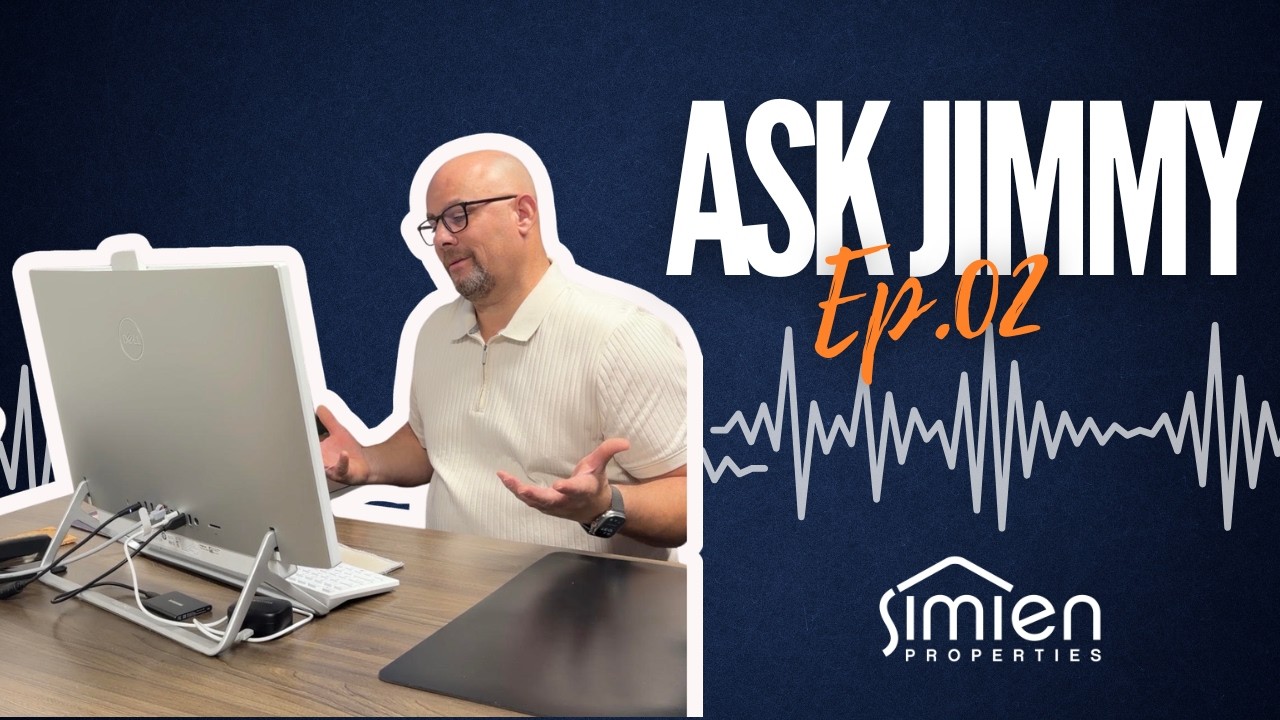
Episode 2: Inspection Repairs & Terminations in a Buyer's Market
Jimmy Simien and Joe Haas talk about how more homes for sale has changed buyer behavior: buyers are moving slower, sending long repair lists after the inspection, and ending contracts over small items. They walk through real deals, including a League City sale lost over two 10-year-old AC units that a licensed HVAC technician said didn't need replacing, and explain how buyers and sellers can keep emotion out of the negotiation.
Past Episodes
Every weekly episode and monthly roundtable is archived here, newest first.
Houston Real Estate Questions, Answered
Real questions from Ask Jimmy sessions, grouped by topic and answered in full.
Pricing and Preparing to Sell
Price against homes like yours that actually closed nearby recently, usually in the last three to six months, not against what a neighbor is currently asking or what the market looked like a couple of years ago. Active listings show what sellers hope to get; recent closed sales show what buyers are actually paying, and that gap is what determines how a new listing gets received. In our pricing conversation, Jimmy points out that six months of comparable sales can look right on paper while the market has already moved, so weight the newest sales most and check them against what's listed today.
Not when buyers have plenty of homes to choose from. Buyers compare every listing with the others, so an overpriced home tends to get skipped rather than negotiated down, and it sits while the seller keeps paying to carry it. Jimmy's advice in our pricing conversation is to price in the sweet spot from the start, and in our rates and buydowns conversation he adds that sellers should expect a buyer to ask for help with closing costs, rather than padding the list price.
Remove it. Paint applied directly over wallpaper tends to telegraph itself once humidity reaches the seams, especially in a Gulf Coast climate, and a buyer (or their inspector) who spots it starts wondering what else got a shortcut treatment. A clean, neutral repaint after removal is one of the more reliably cost-effective updates before listing, and it reads as genuine upkeep rather than a patch job.
Inspections and Repair Requests
Focus on the systems that are expensive to fix and hard to ignore, not the length of the report itself: roof condition, foundation, HVAC age, plumbing, electrical, and any sign of past water intrusion. In the Houston area specifically, HVAC systems run nearly year-round and foundations sit on expansive clay soil, so both deserve a closer look than they might elsewhere. In Texas, a buyer's real leverage here comes from the option period: while it's still open, you can request repairs, ask for a credit, or terminate the contract altogether, forfeiting only the (typically small) option fee rather than any real penalty.
A must-have affects safety, structure, or a major system: an active roof leak, foundation movement an engineer flags as active, failing HVAC, or an electrical hazard. A nice-to-have is everything you'd likely change anyway if you owned the home, like dated fixtures, cosmetic wear, or an older-but-functional appliance. Treating the second category as leverage tends to cost buyers goodwill in negotiations without moving the needle much on price.
Because they have options. When more homes are for sale, a buyer who doesn't get every repair they asked for can terminate during the option period and move on to the next house. In Ask Jimmy Episode 2, Joe Haas described a deal on a newer home in Rosharon that ended over minor electrical items such as a missing GFCI outlet, and a League City sale lost over two 10-year-old AC units that a licensed HVAC technician said didn't need replacing. Walking away still costs the buyer: the inspection and the option fee are already spent, which Jimmy puts at around $1,000 together. Our guide on why home sales fall through after the inspection covers the numbers behind it.
Often, when the items are small. Joe Haas's advice in Episode 2 is not to give a picky buyer a reason to terminate: if the list is light bulbs, a $2 gas cap and similar minor fixes, doing all of it usually costs far less than losing the buyer and going back on the market. Big-ticket items are different. Those are worth negotiating as a repair, a credit or a price adjustment, based on what a licensed professional says the item actually needs.
When there's a significant problem and the two sides can't agree, terminating is reasonable. Walking away over a few hundred dollars rarely is: by then you've paid for the inspection and the option fee, and the next house will have its own list, because no house is perfect, new construction included. Jimmy and Joe's advice in Episode 2 is to weigh the whole deal, including the price you negotiated and the home you wanted, and to keep emotion out of the decision.
Closing Costs, Rates and Buydowns
Buyer closing costs typically run 2% to 5% of the purchase price, covering lender fees, title work, and prepaid taxes and insurance; Texas has no state transfer tax, which keeps that total a bit lower than in many other states. Sellers can also contribute toward a buyer's closing costs as part of an offer, capped at a dollar amount the contract specifies. The real limits on how that money gets used come from the buyer's lender, though: loan-program rules generally cap seller contributions as a percentage of the price and restrict them to legitimate settlement charges, never a buyer's down payment or cash back at closing.
For many buyers, yes. A $10,000 price cut on a 30-year loan at 7% lowers the monthly payment by about $67 ($66.53). If the seller instead puts that $10,000 toward your closing costs and it buys your rate down half a point, from 7% to 6.5% on a $400,000 loan, the payment drops by about $133 a month, for the life of the loan. How far $10,000 moves your rate depends on the lender and the loan, so get a quote for both options before you choose, as Jimmy explains in our rates and buydowns conversation. Our guide on whether a rate buydown beats a price reduction works through the numbers.
About $67 a month on a 30-year loan at 7% ($66.53), or about $90 on a 15-year loan at the same rate ($89.88). It barely changes your cash to close, either: with 3.5% down, a price $10,000 lower saves $350 at closing. At $67 a month, it would take about 12½ years of payments to add up to $10,000, which is why we often suggest asking for the same money as a credit toward a rate buydown instead.
Not really. Selling at $410,000 with a $10,000 credit toward the buyer's closing costs nets the seller about the same as selling at $400,000, because the credit comes out of the seller's proceeds either way; the small difference is the commission on the higher price. The home still has to appraise at the higher price, and the buyer's lender sets how much a seller may contribute and what it can pay for. Jimmy walks through this in our rates and buydowns conversation. Our guide on whether a rate buydown beats a price reduction works through the numbers.
Not necessarily. Rates can rise as well as fall, and prices don't wait either. Nobody can call where rates go next, as Jimmy says in our pricing conversation, so waiting for a drop is a bet. If you find the right house at a payment you can afford, buying now and refinancing if rates drop later is one way to avoid betting on the timing. A refinance has its own costs and means qualifying again, so ask a lender to run both scenarios for you.
RSVP for Ask Jimmy or Send a Question
Send your question ahead of time, or let us know you'd like to join the next Live Roundtable. We'll email you the Zoom details ahead of the call.
Or call us directly at (281) 280-8675.