
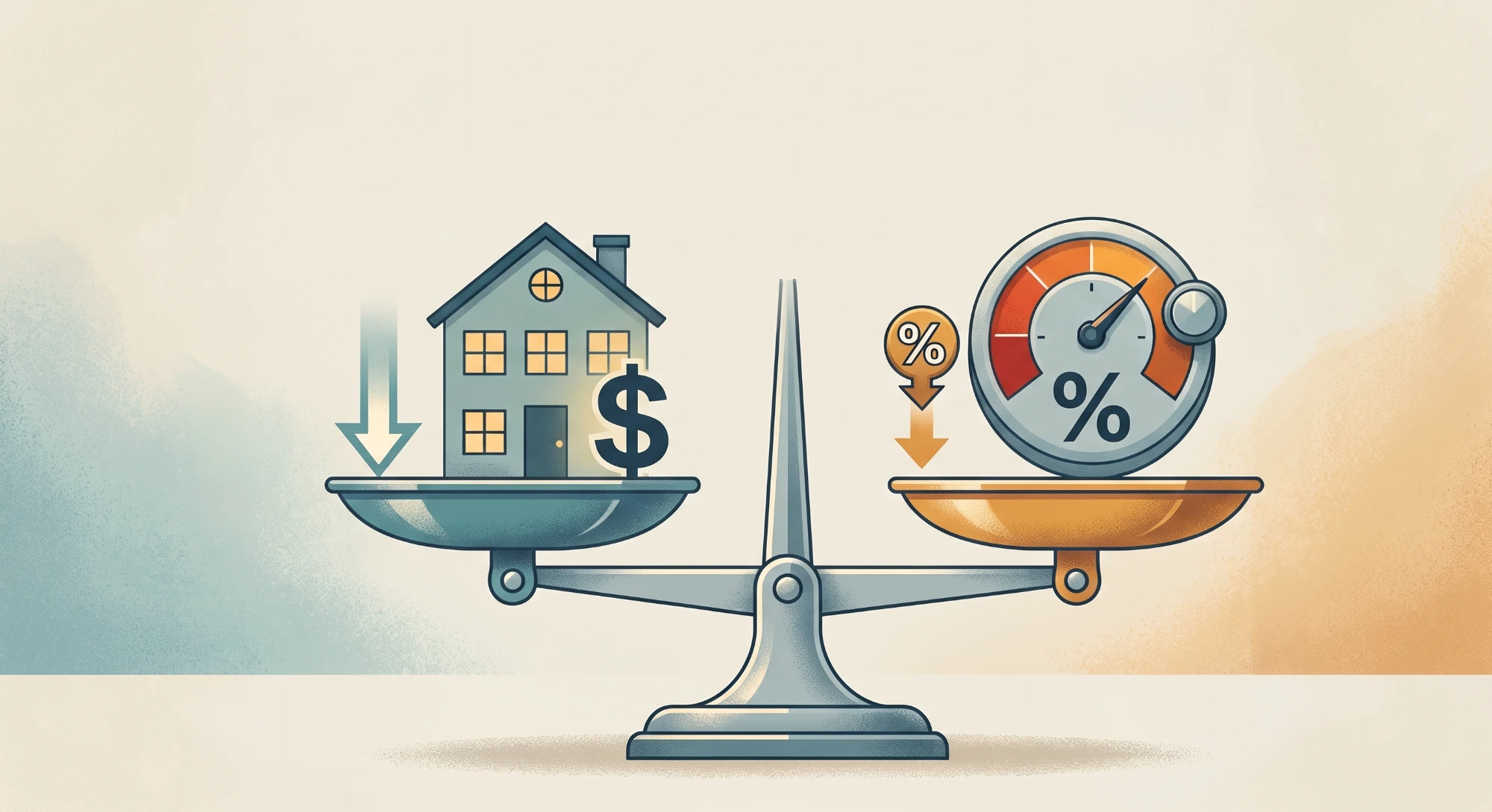
The same $10,000 from a seller can lower your payment by about $65 a month or by several hundred, depending on where it goes.
For most buyers financing a home in Houston right now, a seller credit used to buy down the interest rate lowers the monthly payment more than the same dollars taken off the price. On a $410,000 home with 5% down at today’s average rate, a $10,000 price cut saves about $65 a month. Put that $10,000 toward the rate and it saves roughly $170 a month for the life of the loan, or about $500 a month in the first year, depending on the type of buydown.
A price cut still wins in some situations, and we cover those below. Most negotiations we see never get that far, because both sides are fixed on the number at the top of the contract. “People are so focused on winning the price war on the sales price, and they’re not realizing they potentially are costing themselves more,” said Jimmy Simien, Broker/Owner of Simien Properties, in a recent Ask Jimmy conversation you can listen to in full in our Past Episodes library (opens in a new tab).
How Much Does a $10,000 Price Reduction Lower Your Monthly Payment?
A $10,000 price reduction lowers a 30-year mortgage payment by about $65 to $68 a month at current rates. Every $10,000 borrowed at 7.28% costs $68.42 a month in principal and interest. At an even 7% it costs $66.53, close to the $67 Jimmy uses on the episode.
It doesn’t save much at closing either. With an FHA loan and 3.5% down, taking $10,000 off the price reduces your down payment by $350. With 5% down on a conventional loan, it’s $500. You bring nearly the same cash to the table, and the payment barely moves.
A price cut does have real advantages. The savings last as long as the loan does, and you owe less from the first day. For a buyer whose main worry is the monthly payment, though, $65 is a small return on a concession many sellers are still holding firm on. Principal and interest are also only part of the bill, and our guide on what buyers often miss when calculating a monthly payment in Houston walks through the rest.
How High Are Mortgage Rates for Houston Buyers Right Now?
The 30-year fixed rate averaged 7.28% as of October 1, 2026, according to Freddie Mac’s weekly survey. It was 7.03% a week earlier and 6.34% a year ago.
Jimmy has seen higher. “I bought my first house in 1997, and it was 8%, but my house was only $99,000,” he says. He puts that same house at about $350,000 in Clear Lake today. Rates were higher then, but the loan was less than a third the size, which is why 7% weighs so much more on a payment now. He isn’t counting on a return to the lows, either. Of the 2.625% rate he locked five years ago, he says, “Those rates aren’t coming back anytime soon, and maybe they won’t come back in my lifetime.”
The Houston Association of REALTORS’ August 2026 Housing Market Update, released September 9, 2026, shows how buyers were responding even before the latest jump:
- Single-family home sales: 7,100, down 11.5% year over year
- Active listings: 38,947, up 0.5% year over year
- Months of supply: 5.3
- Average days on market: 54, up from 52 a year ago
- Median sale price: $330,000, down 1.5% year over year
Redfin’s reports from September 10 and September 18, 2026 show who holds the leverage:
- Home sellers outnumbering buyers in Houston in August: 131% more sellers than buyers, behind only Nashville and Miami among major U.S. metros
- Houston home sales that included a seller concession, three months ending August 31: 58.5%
Buyers have room to ask, and most Houston sellers are already giving something. What’s still open in most deals is the form that concession takes.
How Much Can a $10,000 Rate Buydown Save Each Month?
A $10,000 seller credit put toward the rate saves between roughly $170 and $500 a month on that same $410,000 home, depending on whether the buydown is permanent or temporary.
A permanent buydown uses discount points. One point costs 1% of the loan amount, and a common rule of thumb is that each point lowers the rate by about a quarter of a percentage point. Freddie Mac’s homebuyer guidance notes the actual reduction varies by lender. Whether points pay off depends on how long you keep the loan, which is why the five-year math further down matters. A temporary buydown, most often a 2-1, lowers your rate by two percentage points in year one and one point in year two, then returns to the full rate. The seller’s credit funds an account that covers the difference.
| Where the $10,000 goes | Monthly principal and interest | Savings against no concession |
|---|---|---|
| No concession, $410,000 at 7.28% | $2,665 | None |
| Price cut to $400,000 | $2,600 | $65, for the life of the loan |
| Permanent buydown to about 6.64% | $2,497 | $168, for the life of the loan |
| 2-1 temporary buydown | $2,158 in year one, $2,406 in year two, $2,665 after | $507 in year one, $259 in year two, none after |
These figures are our illustration, assuming 5% down and a 30-year fixed loan at Freddie Mac’s October 1 average. The 2-1 buydown costs about $9,200 on this loan, which leaves the rest of the credit for other closing costs. Your lender’s Loan Estimate sets the real numbers, and Jimmy is the first to say so: “I’m not a loan officer, I’m not a mortgage person.” It’s why we get a buyer in front of a lender before we write the offer. The direction holds either way. “The benefit is greater getting [a] closing cost contribution to do a rate buydown than it is to do a price reduction. So we can’t just focus on price,” he says. Given the choice himself, he doesn’t hesitate: “I do a rate buydown all day. I could care less about the $10,000 principal reduction.”
Two rules matter with a temporary buydown. Under Fannie Mae’s guidelines, your lender qualifies you at the full note rate, so the lower early payment won’t help you qualify for more house. If you refinance or sell before the funds are used up, what’s left is credited toward your payoff or returned as the buydown agreement specifies. Points paid on a permanent buydown don’t come back when you refinance, so a buyer who expects to refinance once rates ease is often better served by the temporary version.
Does a Seller Credit Cost the Seller More Than a Price Reduction?
No, or very close to it. A seller who accepts $410,000 and credits $10,000 at closing nets about what they’d net accepting $400,000. “It’s the same net-net to them. They get the same amount of money at closing. It’s just an accounting shift,” Jimmy says.
There are two caveats. Costs that are figured on the sales price, like commission, come out a little higher on the larger number. The home also has to appraise at the higher price, and if the comparable sales support $400,000 but not $410,000, the credit version can stall with the lender.
In Texas, the credit has a specific home in the contract. The Texas Real Estate Commission’s One to Four Family Residential Contract, form 20-19, has been required since July 1, 2026. Its Paragraph 12A(1)(b) is a blank where the seller agrees to pay up to a set dollar amount toward the buyer’s closing expenses. Your agent writes the number in when you make the offer, and it can go toward points or a buydown as long as your lender allows it. It can’t be used for your agent’s fee, which now has its own line in Paragraph 12B. This is general information, not lending or legal advice; your lender and your agent can tell you how it applies to your loan and your contract.
Some sellers bristle at the request because they don’t see why a buyer who can afford the house needs help closing. Jimmy’s answer to them: “Sometimes people are using every dime they can get to get into a house, and they don’t have extra money.” To a seller who refuses on principle, he asks, “Why wouldn’t you? If your net number is your net number ... it makes no difference.” Few sellers are choosing between buyers right now anyway. “Generally speaking, we’re getting one offer here, one offer there,” he says.
When Is a Price Reduction the Better Choice?
A price reduction is the better choice when there’s no loan to improve, or when you won’t keep the loan long enough for the lower rate to pay off.
- You’re paying cash. With no rate to buy down, every dollar off the price is a dollar saved.
- You expect to sell or refinance within about five years. In our example, the permanent buydown leaves you owing about $9,500 more than the price cut would. Its payment advantage over the price cut is about $103 a month, and that doesn’t overtake the larger balance until a little past year five.
- The price is too high to begin with. A credit stacked on a price the appraisal won’t support doesn’t fix the price.
- You’ve hit your loan’s limit. Fannie Mae caps seller-paid financing concessions on a conventional loan at 3% of the sales price or appraised value, whichever is lower, when you put less than 10% down. The cap is 6% with at least 10% down and 9% with 25% or more. FHA and VA loans set their own limits, so ask your lender which one applies to you. A credit also can’t exceed your actual closing costs.
- You’d struggle once a temporary buydown ends. From year three on, the 2-1 payment in our example runs $65 a month higher than the price-cut payment, on a balance about $9,300 larger.
How Should Buyers and Sellers Use a Rate Buydown in a Negotiation?
Start with what the buyer is actually short on. Jimmy wants agents asking two questions on the front end: “Are they rate sensitive? Are they cash sensitive?” A cash-sensitive buyer needs the credit to cover closing costs. A rate-sensitive buyer can put the same credit toward the payment.
If you’re buying, see a lender before you make an offer and ask for the loan priced three ways: a lower price, permanent points, and a 2-1 buydown. Then decide how long you realistically expect to keep the loan, because that answer picks the winner more often than the rate does.
If you’re selling, expect the closing-cost request and judge every offer by your net. Price comes first, and our guide on how to price your home given the expanded inventory covers that step. A credit that keeps a qualified buyer in the deal usually costs less than starting over.
“There’s no point in creating adversarial positions between buyers and sellers,” Jimmy says.
The Bottom Line
Before you negotiate the price, ask a lender what the same dollars would do to your rate. For most financed buyers in Houston, a seller credit toward a rate buydown lowers the monthly payment more than an equal price reduction, at about the same cost to the seller. A price cut is still the better ask for cash buyers, short stays, and homes priced above what they’ll appraise for.
Weighing a price cut against a credit on a specific home? Let’s talk through your options. Call our no-pressure concierge line at (281) 781-4348 or visit simienproperties.com.
References
- Freddie Mac, Primary Mortgage Market Survey, weekly average as of October 1, 2026
- Houston Association of REALTORS, August 2026 Housing Market Update, released September 9, 2026, and the August 2026 Monthly Activity Snapshot
- Redfin, It’s Now The Strongest Buyer’s Market on Record, Driven by the Sun Belt, published September 10, 2026
- Redfin, Nearly Half of Homebuyers Get Concessions From Sellers as Most Markets Tip in Buyers’ Favor, published September 18, 2026
- Fannie Mae Selling Guide, B3-4.1-02, Interested Party Contributions, version dated May 7, 2025
- Fannie Mae Selling Guide, B2-1.4-04, Temporary Interest Rate Buydowns, version dated August 7, 2024
- Freddie Mac My Home, What You Need to Know About Discount Points, accessed October 5, 2026
- Texas Real Estate Commission, One to Four Family Residential Contract (Resale), Form 20-19, effective July 1, 2026
- Texas REALTORS, Latest Forms Changes, Texas REALTOR magazine, May 1, 2026
- Texas Real Estate Commission, Contract Form Updates by Broker-Lawyer Committee, January 2026 meeting recap
- Simien Properties, “Ask Jimmy: Rate Buydowns vs. Price Reductions: Which Saves Buyers More?”, September 11, 2026, audio (opens in a new tab)
Get local guidance before you decide. Call our no-pressure concierge line at (281) 781-4348 or visit simienproperties.com.